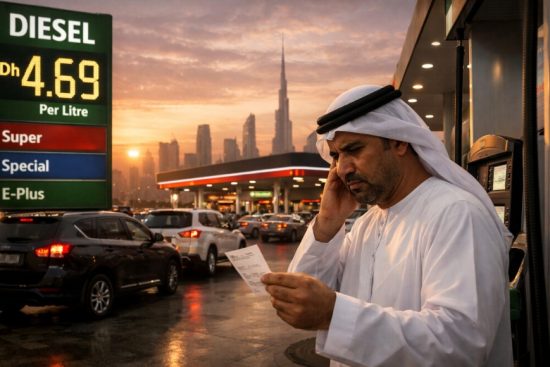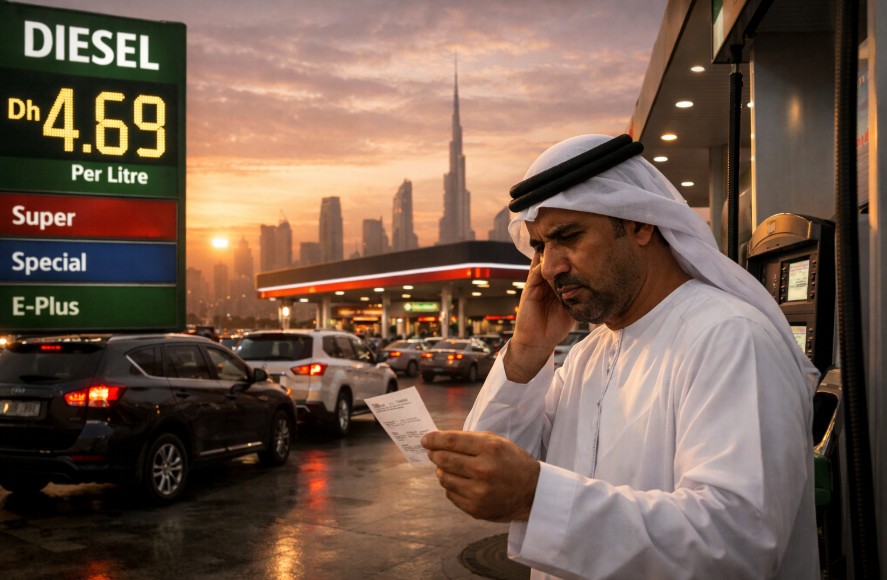
The diesel price in the UAE for April 2026 increased sharply to Dh4.69 per litre, up from Dh2.72 in March. That is a rise of nearly 72%, making it one of the biggest monthly diesel increases in recent years. Petrol prices also moved higher, with Super 98 reaching Dh3.39, Special 95 at Dh3.28, and E-Plus 91 at Dh3.20 per litre.
Key takeaways:
- Diesel increased by Dh1.97 per litre in April
- Petrol prices rose by around 80 fils per litre
- A 60-litre car now costs about Dh48 more to fill
- An 80-litre SUV now costs roughly Dh64 more
- The increase was caused by higher global oil prices, conflict in the Middle East, and disruption in the Strait of Hormuz
- UAE fuel prices change monthly because they follow international market rates
Why Did Diesel Prices Increase So Sharply in April 2026?
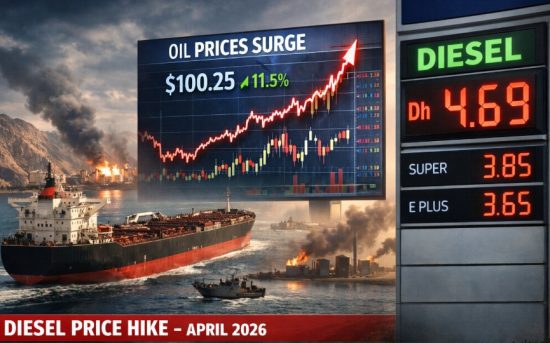
The April 2026 fuel increase did not happen because of a local decision alone. Diesel prices rose because global oil markets changed rapidly during March. The UAE links its monthly fuel prices to international crude oil and refined fuel costs, so when oil became more expensive worldwide, diesel in the UAE also increased.
Diesel saw the biggest jump of all fuel categories, climbing from Dh2.72 to Dh4.69 per litre. Petrol prices rose too, but not as dramatically. This happened because diesel is more sensitive to supply shortages and transport disruptions.
How Did Global Oil Prices Push UAE Diesel Higher?
Global crude oil prices climbed quickly through March 2026. Brent crude, one of the main international oil benchmarks, moved from around $68.92 per barrel in February to more than $92 on average in March. During the final weeks of the month, prices briefly moved close to $110–$120 per barrel.
Because the UAE calculates local fuel prices using global averages, that increase fed directly into April pump prices. Diesel increased more sharply because industrial fuels were already in shorter supply globally.
Important changes in the oil market included:
- Brent crude rising by more than 50% during March
- Refined diesel costs increasing faster than petrol
- Global shipping and fuel supply chains becoming more expensive
- Oil traders pricing in the risk of further shortages
As one energy market analyst quoted in local coverage explained, “Prices have stabilised, but at much higher levels than before.” That shift meant April was not simply a normal monthly adjustment. It reflected a major reset in global fuel costs.
A UAE resident interviewed after the announcement said, “I expected petrol to go up slightly, but I did not think diesel would almost double. For people who drive every day, this makes a real difference to the monthly budget.”
The rise was also amplified because March had started from a relatively low base. Fuel prices had been falling during parts of 2025 and early 2026, so the April jump felt much larger when compared with recent months.
How Did the Middle East Conflict Affect Fuel Prices?
The biggest reason behind the oil surge was the escalating conflict involving the US, Israel, and Iran. Tensions intensified at the end of February and continued through March, creating fears that oil production and shipping in the region could be disrupted.
Investors and fuel markets reacted immediately. Whenever conflict threatens major oil-producing countries, oil prices usually rise because buyers worry there may not be enough supply in the future.
The conflict affected prices in several ways:
- It increased uncertainty across global energy markets
- It raised concerns about whether oil exports from the region could continue normally
- It damaged consumer and business confidence worldwide
- It made traders expect future shortages, which pushed prices even higher
According to market reports, the conflict began on February 28 when military action targeted Iranian leadership and infrastructure. After that, oil prices continued to rise almost every week in March.
One logistics manager in Dubai described the impact by saying, “We started seeing fuel costs rise even before April arrived. Every delivery route became more expensive, and companies immediately had to rethink their budgets.”
Businesses that rely heavily on diesel, such as transport, freight, and construction firms, were among the first to feel the pressure. Diesel is used more widely in trucks, buses, delivery vehicles, and industrial equipment, so a sudden increase affects many parts of the economy.
Unlike petrol, which is mostly used by private drivers, diesel has a wider effect because it can increase the cost of moving goods, running businesses, and delivering products across the UAE.
Why Did the Strait of Hormuz Disruption Matter So Much?
The Strait of Hormuz became one of the biggest reasons for the April fuel shock. This narrow shipping route is one of the most important oil corridors in the world. Around 20% of global oil passes through it every day.
When ships and tankers faced restrictions and delays in the Strait of Hormuz during March, global markets reacted immediately. Oil companies and traders feared that supply could slow down or stop.
That mattered because:
- The UAE and many neighboring countries depend on oil shipments through the strait
- Tanker delays reduced the amount of oil reaching global markets
- Shipping costs rose sharply
- Countries began competing for limited fuel supplies
The situation became more serious when energy facilities in Iran and Qatar were also affected. That created additional concerns that both crude oil and refined fuel production could remain limited for weeks.
A transport company owner in Abu Dhabi summed up the situation by saying, “When the Strait of Hormuz is disrupted, everyone feels it. Diesel becomes more expensive, deliveries cost more, and businesses have no choice but to pass some of that cost on.”
The disruption also explains why diesel increased more than petrol. Diesel relies heavily on industrial transport networks, shipping, and refining. Once those systems face delays, diesel prices usually rise faster than regular petrol.
How Much More Will You Pay for Diesel and Petrol in April 2026?

The April 2026 fuel update means most UAE drivers will notice a clear increase every time they fill up. Petrol prices rose by around 80 fils per litre, while diesel surged by nearly Dh2 per litre.
For many households, the biggest change is not the price per litre itself. It is how much more each full tank now costs. Even a small increase at the pump can add up quickly over a month, especially if you drive long distances, commute daily, or use a larger vehicle.
Diesel drivers are seeing the biggest impact. A rise from Dh2.72 to Dh4.69 per litre means each refill now costs substantially more than it did in March.
How Much More Does a 60-Litre Car Tank Cost?
For a typical sedan with a 60-litre tank using Special 95 petrol, the increase is easy to calculate.
In March:
- 60 litres × Dh2.48 = Dh148.80
In April:
- 60 litres × Dh3.28 = Dh196.80
That means you now pay roughly Dh48 more every time you fill the tank.
If you drive to work every day, take children to school, or travel frequently between emirates, that difference becomes noticeable very quickly. A single monthly refill may not seem too severe, but most drivers fill up several times each month.
Many residents said the increase came as a surprise because fuel prices had been more stable earlier in the year. One Dubai commuter explained, “My usual fill-up was around Dh150 in March. Now it is close to Dh200, and that changes what I spend every week.”
For drivers of compact cars and small sedans, the extra cost generally ranges between Dh40 and Dh50 per tank depending on fuel type.
How Much More Does an 80-Litre SUV or 4×4 Cost?
The increase is even more noticeable if you drive a larger SUV or 4×4. These vehicles often have fuel tanks of around 80 litres and are common in the UAE.
For an 80-litre SUV using Special 95 petrol:
In March:
- 80 litres × Dh2.48 = Dh198.40
In April:
- 80 litres × Dh3.28 = Dh262.40
That is an increase of approximately Dh64 every time you refill.
Drivers using Super 98 petrol may pay even more. For some larger vehicles, a full tank now costs over Dh270 depending on the fuel type.
The April increase matters particularly for:
- Families who use larger vehicles every day
- People who travel long distances for work
- Residents who regularly drive between Dubai, Abu Dhabi, Sharjah, and other emirates
- Business owners who operate SUVs, vans, or company vehicles
The cost difference is significant because many SUV owners refill once or twice every week. That means the extra amount paid in April could easily exceed Dh250 each month.
How Much Could Frequent Drivers Spend Each Month?
Drivers who refill often will see the greatest impact. If you fill up twice a week, the higher April prices can add several hundred dirhams to your monthly budget.
For example:
- A sedan driver paying an extra Dh48 per fill and refuelling twice a week may spend around Dh384 more each month
- An SUV driver paying an extra Dh64 per fill may spend around Dh512 more each month
That estimate is especially important for:
- Taxi and ride-hailing drivers
- Delivery workers
- Sales professionals
- Families with long daily commutes
- Small business owners using diesel vans or trucks
Diesel users face even higher monthly increases because the jump in diesel prices was much steeper than petrol. A business that operates several delivery vehicles could see hundreds or even thousands of dirhams in additional monthly fuel expenses.
To reduce the effect of rising prices, many UAE residents are already changing how they drive. Common strategies include:
- Combining trips instead of driving several times a day
- Sharing rides with colleagues or family members
- Keeping tyres properly inflated
- Driving more smoothly to reduce fuel use
- Using public transport for some journeys when possible
Even though the increase is sharp, fuel prices can move down again if global oil markets stabilise. For now, however, April 2026 is likely to be remembered as one of the most expensive months for diesel users in the UAE.
Why Does the UAE Change Fuel Prices Every Month?
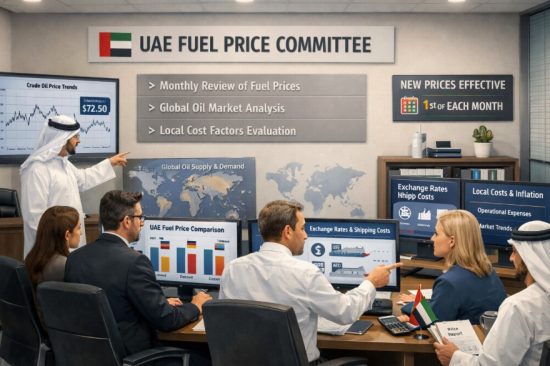
The UAE changes fuel prices every month because the country follows a deregulated fuel pricing system introduced in 2015. Before then, petrol and diesel prices were fixed. Today, the UAE Fuel Price Committee reviews international oil markets at the end of each month and announces new local rates.
The system is designed to make UAE fuel prices reflect what is happening globally. When crude oil prices rise, local prices usually rise. When global oil prices fall, UAE motorists can also benefit from lower prices.
The monthly review considers:
- Average international crude oil prices
- Refined fuel costs
- Shipping and distribution expenses
- Operating costs for fuel companies
This approach allows prices to adjust more quickly than in countries where the government subsidises fuel. Nations such as Saudi Arabia, India, and China often delay price increases because they use stronger price controls.
In the UAE, however, changes are usually applied immediately from the first day of each month. That is why the March oil rally quickly appeared in the April 2026 diesel price.
How Does the April 2026 Diesel Price Compare With Previous Months and Years?
April 2026 stands out because diesel recorded one of the largest month-on-month increases seen in recent years. The price rose from Dh2.72 in March to Dh4.69 in April, an increase of around 72.4%.
This was far greater than the increase seen in petrol prices, which rose by around 31% to 33%. The scale of the increase shows how severely diesel supply was affected by global market disruption.
| Fuel Type | March 2026 | April 2026 | Increase |
| Diesel | Dh2.72 | Dh4.69 | +72.4% |
| Super 98 | Dh2.59 | Dh3.39 | +30.9% |
| Special 95 | Dh2.48 | Dh3.28 | +32.3% |
| E-Plus 91 | Dh2.40 | Dh3.20 | +33.3% |
Compared with April 2025, the trend is even more striking. Petrol prices are now around 30% to 35% higher than a year ago, while diesel is almost 80% higher.
That comparison suggests the UAE fuel market has moved from a period of lower prices in 2025 to a much more volatile environment in 2026. The jump also confirms that diesel remains the fuel under the greatest pressure worldwide because of shipping disruptions and reduced industrial supply.
How Do UAE Diesel Prices Compare With Other Countries?
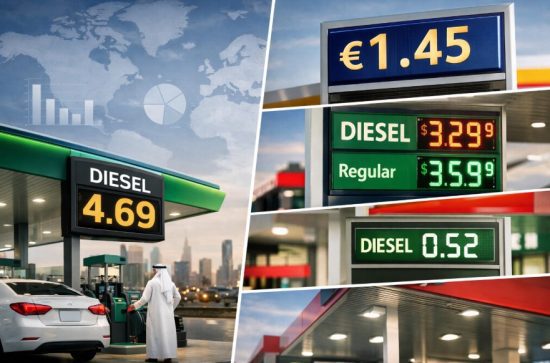
Even after the April increase, UAE fuel prices remain around the middle of the global range. Diesel in the UAE is now more expensive than in some neighboring countries with subsidies, but still cheaper than in many parts of Europe.
Several countries also experienced sharp fuel increases in March and April 2026:
- The Philippines and Nigeria reported diesel increases of more than 80%
- Australia saw fuel prices rise by over 50%
- Petrol in the United States moved above $5 per gallon
- Pakistan increased diesel prices by nearly 55% in April
Countries such as Saudi Arabia, India, and China experienced smaller increases because governments continue to regulate or subsidise prices.
European drivers still generally pay more than UAE motorists because fuel taxes are much higher. In countries like Germany, France, and the UK, petrol and diesel often cost significantly more even when crude oil prices are lower.
The UAE remains relatively competitive internationally, but the April rise still represents a major change for local households and businesses.
Which Sectors and People in the UAE Will Be Most Affected by Higher Diesel Prices?
The sectors most affected by higher diesel prices are transport, logistics, freight, delivery, construction, and commercial fleets. These industries rely heavily on diesel-powered vehicles and equipment, so a rise of nearly Dh2 per litre has a direct effect on operating costs.
Businesses likely to feel the biggest pressure include:
- Trucking and cargo companies
- Food delivery services
- Taxi and ride-hailing operators
- Construction firms
- Retailers that move goods across the UAE
For ordinary residents, the effect may appear in several ways beyond simply paying more at the petrol station.
Higher diesel prices can eventually increase:
- Delivery charges
- Taxi fares
- Food and supermarket prices
- Moving and transport costs
Families with large vehicles or long daily commutes are also likely to feel the greatest impact. People driving between emirates several times a week may need to spend hundreds of dirhams more every month.
Because diesel is used across so many industries, rising diesel costs often spread through the wider economy very quickly.
Could UAE Diesel Prices Rise Again in the Coming Months?

Diesel prices could rise again if global oil markets remain unstable. Much depends on what happens to crude oil prices, the conflict in the Middle East, and shipping through the Strait of Hormuz.
At the moment, oil prices have stopped rising as quickly as they did in March, but they are still much higher than earlier in the year. If supply improves and regional tensions ease, UAE fuel prices may begin to fall in May or June.
However, further disruption could keep prices high or even push them higher.
The next few months will depend on:
- Whether oil exports return to normal
- Changes in Brent crude prices
- The condition of shipping routes
- Decisions by global oil producers
The UAE’s monthly pricing system means motorists will continue to see changes quickly. That can work both ways: prices can rise rapidly, but they can also fall just as fast when global conditions improve.
Conclusion
The April 2026 diesel price increase is one of the sharpest fuel changes the UAE has seen in years. Diesel rose to Dh4.69 per litre because of a global oil surge, conflict in the Middle East, and disruption to one of the world’s most important oil routes.
For you, the biggest effect is practical. Filling up your car now costs noticeably more, especially if you drive a larger vehicle or travel often. Businesses that rely on diesel are also facing much higher operating costs, which may affect prices across the wider economy.
Even so, UAE fuel prices remain linked to global markets, which means they can fall again if oil prices ease and regional tensions improve. Until then, understanding why prices changed can help you plan your monthly fuel budget more effectively.
FAQs
What is the official diesel price in the UAE for April 2026?
The official diesel price in the UAE for April 2026 is Dh4.69 per litre. This new rate took effect on April 1, 2026.
Why is diesel more expensive than petrol in April 2026?
Diesel became more expensive because global diesel supplies were hit harder by shipping delays and refinery shortages. Diesel is also used more heavily in transport and industrial sectors, which increased demand.
How much more will a typical UAE driver pay each month?
A driver with a small sedan may spend around Dh380 more each month if they refuel twice a week. SUV and 4×4 drivers could pay more than Dh500 extra each month.
Who decides fuel prices in the UAE every month?
The UAE Fuel Price Committee reviews global oil and fuel market prices at the end of each month. It then announces new petrol and diesel prices that apply from the first day of the next month.
Could diesel prices fall again after April 2026?
Yes, diesel prices could fall if global oil prices decrease and regional tensions improve. Because the UAE uses a monthly pricing system, lower international prices can quickly reduce local fuel costs.
Are UAE diesel prices still cheaper than in Europe?
Yes, diesel prices in the UAE are still generally lower than in most European countries. European motorists usually pay more because of higher taxes and fuel duties.
Where can you check the latest UAE fuel prices each month?
You can check the latest UAE fuel prices through official announcements from the UAE Fuel Price Committee and major UAE news websites. New fuel prices are usually published at the end of every month for the following month.