
The UAE announced a decrease in fuel prices for January 2026, bringing welcome relief to motorists. Super 98 is now priced at AED 2.53, Special 95 at AED 2.42, E-Plus 91 at AED 2.34, and Diesel at AED 2.55 per litre. This marks a noticeable decline from December 2025 levels due to global oil market adjustments and currency fluctuations. The UAE continues to review prices monthly, and further changes are expected throughout the year.
Key Takeaways:
- January 2026 petrol and diesel prices dropped compared to December 2025.
- Super 98 decreased from AED 2.70 to AED 2.53.
- Fuel prices in the UAE are deregulated and align with global trends.
- Price changes depend on oil market shifts, USD-AED exchange rates, and geopolitics.
January 2026 Fuel Prices Announced by the UAE Fuel Price Committee
Fuel prices for January 2026 were officially announced by the UAE Fuel Price Committee at the end of December, in line with the nation’s monthly pricing policy.
These rates became effective from January 1, 2026, offering a decrease across all major fuel types compared to the previous month. The pricing adjustment reflects global economic and energy market movements, helping UAE residents plan their transportation and fuel expenses more accurately.
The UAE adopted a deregulated fuel pricing system in 2015, allowing domestic fuel rates to align with international market trends. This policy has ensured transparency and fair pricing, with the committee evaluating global crude benchmarks, refining margins, and currency exchange rates before finalising monthly prices.
This proactive system ensures that the UAE public receives timely updates while responding swiftly to global oil market shifts. Motorists in the UAE benefited from this policy in January, enjoying lower pump prices due to a drop in global oil rates, providing both personal and commercial financial relief across the country.
What Are the Current UAE Fuel Prices in January 2026?

In January 2026, the UAE’s fuel prices saw a significant reduction across all categories. These prices are applicable across all seven emirates and reflect a countrywide standard, not varying between Dubai, Abu Dhabi, or any other emirate. The reduction is linked to falling crude oil prices globally and adjustments in refining costs.
Here are the confirmed fuel prices for January 2026:
- Super 98 Petrol: AED 2.53 per litre (down from AED 2.70)
- Special 95 Petrol: AED 2.42 per litre (down from AED 2.58)
- E-Plus 91 Petrol: AED 2.34 per litre (down from AED 2.51)
- Diesel: AED 2.55 per litre (down from AED 2.85)
This notable drop has helped drivers better manage their commuting budgets. Whether for personal vehicles or business fleets, lower fuel costs can influence planning, cost control, and operational efficiency.
Monthly Fuel Price Comparison Table (Nov 2025 – Jan 2026)
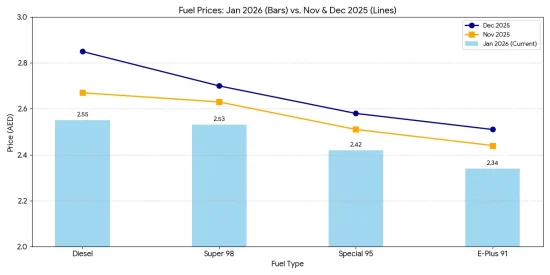
The table below outlines the price changes over the last three months for each fuel type, highlighting the January 2026 drop.
Fuel Type Jan 2026 Dec 2025 Nov 2025
Super 98 AED 2.53 AED 2.70 AED 2.63
Special 95 AED 2.42 AED 2.58 AED 2.51
E-Plus 91 AED 2.34 AED 2.51 AED 2.44
Diesel AED 2.55 AED 2.85 AED 2.67
This consistent tracking offers a clear view of fuel market behaviour over recent months, allowing drivers to understand pricing trends better and forecast future movement.
Lower January rates have provided much-needed relief, but fluctuations are expected to continue through the year.
Why Did Fuel Prices Decrease in January 2026?
Fuel prices in the UAE dropped notably in January 2026, offering some relief to motorists and businesses alike. This reduction wasn’t accidental, it reflected a combination of international economic shifts, local currency strength, and energy sector adjustments. Below is a breakdown of the most significant factors that contributed to the drop in petrol and diesel prices this month.
Global Crude Oil Price Adjustments
One of the most immediate drivers behind January’s lower prices was a decline in international crude oil benchmarks. Both Brent and West Texas Intermediate (WTI) saw softer trading at the end of December 2025.
This easing came after a year of fluctuation, with markets responding to higher-than-expected inventory levels and signs of cooling demand across Asia and Europe. Lower crude costs directly reduce refinery input prices, ultimately pulling down fuel prices in retail markets like the UAE.
Stronger US Dollar vs AED
The UAE Dirham is pegged to the US dollar, meaning any shift in the value of the dollar impacts purchasing costs. During late 2025, the US dollar strengthened against major global currencies, including those of several oil-exporting countries. As a result, the UAE could acquire oil at relatively better rates, contributing to lower domestic fuel prices.
Supply/Demand and Stockpile Changes
Supply chain data revealed an increase in global crude oil stockpiles. This rise in inventory, particularly from the US and some OPEC+ countries, helped stabilise oil availability and cooled prices. Additionally, demand declined slightly following the holiday season, easing pressure on prices and allowing the UAE Fuel Price Committee to revise rates downward.
Geopolitical Factors Stabilising
While geopolitical tension remains a factor in oil price volatility, the final weeks of 2025 saw a temporary easing. Although the Russia–Ukraine conflict and Venezuelan sanctions persisted, they didn’t escalate further in December. This helped reduce the premium that traders typically apply to account for risk, which in turn kept prices contained.
Lower Refining Costs
Another contributor was a drop in refining margins, particularly in Asia and the Middle East. Lower operational costs at refineries meant fuel could be processed and distributed more cheaply, which influenced the UAE’s pricing model and resulted in lower pump prices.
Expert Comments from Oil Economists
Regional analysts and energy economists noted that January’s drop is in line with broader supply chain corrections. They emphasised that the outlook remains volatile, with fuel prices likely to change depending on how inventories, demand, and geopolitical events unfold.
However, the current pricing trend reflects a short-term correction in a previously overheated market. Together, these factors created a rare moment of price relief for UAE motorists. While beneficial, experts caution that such dips may be short-lived in a globally dynamic oil environment.
How Will UAE Fuel Prices Change in 2026?

Fuel prices in the UAE during 2026 are expected to continue fluctuating based on global and regional economic indicators. Since the UAE follows a deregulated system, monthly price shifts will align with crude oil prices, currency dynamics, and supply-demand changes.
Predictions suggest that prices might remain stable in the short term, especially if global inventories remain high. However, a sudden surge in geopolitical tension or production disruption in major oil-exporting countries could push prices up unexpectedly.
Economic analysts have pointed out that supply chain issues, inflationary pressures, and regional fuel demand are variables to monitor closely. Furthermore, decisions from OPEC and non-OPEC producers will significantly influence fuel costs in the months ahead.
Motorists should anticipate possible fluctuations and plan accordingly. Price updates will continue to be announced on the last day of each month, giving drivers a regular forecast to adapt to changing market realities.
What Does the 2026 Fuel Price Trend Mean for UAE Motorists?
For UAE residents, the drop in January 2026 fuel prices brings immediate relief, but it also signals the need for strategic budgeting throughout the year. With petrol and diesel prices directly linked to global markets, UAE motorists must remain vigilant about ongoing changes.
A decline in rates means lower monthly expenses for personal and commercial transport. Logistics firms, in particular, benefit from this dip, as fuel accounts for a significant share of operating costs. Households also gain from reduced commuting expenses, allowing more room in their monthly budgets.
However, potential price increases later in the year could offset these savings if global oil supply tightens. Hence, it’s essential for consumers to make financial plans that are adaptable.
Fuel price trends act as a mirror of broader economic forces. They affect inflation, transport costs, and even retail pricing. For this reason, staying informed and proactive is vital for everyone relying on vehicles in the UAE.
How UAE Residents Can Adapt to Fuel Price Changes?

With fuel prices in the UAE reviewed monthly and influenced by global factors, residents need to adopt smarter strategies to manage their transportation costs. While January 2026 brought a welcome reduction, the trend may not remain stable throughout the year.
By adjusting habits and leveraging available tools, drivers can minimise the impact of fluctuating fuel prices on their daily lives and budgets.
Smart Commuting & Carpooling
One of the most effective ways to reduce fuel expenses is to cut down on solo trips. Carpooling with colleagues, neighbours, or friends helps distribute fuel costs across more passengers.
For those commuting to the same workplace, this can lead to significant monthly savings. In urban areas like Dubai and Abu Dhabi, public transport options such as the Dubai Metro, buses, and shared taxi services offer additional alternatives to private vehicle use.
Carpooling also reduces traffic congestion and contributes to environmental sustainability. Even choosing to work remotely one or two days a week, if feasible, can greatly reduce fuel use over time.
Monitoring Monthly Updates
Since fuel prices in the UAE are updated at the end of every month, staying informed is essential. Residents should regularly check updates released by the UAE Fuel Price Committee or official news outlets.
Being aware of upcoming changes allows motorists to refuel strategically, for example, topping up before a price hike takes effect or planning long-distance travel around lower-price periods.
Timely knowledge also helps residents adjust their monthly fuel budgets in advance, reducing the likelihood of unexpected financial strain.
Planning Fuel Consumption
Thoughtful planning of trips can make a noticeable difference. Grouping errands into one outing, avoiding peak-hour traffic, and eliminating unnecessary trips are simple but impactful ways to conserve fuel.
Drivers should also consider adjusting their driving habits, such as reducing excessive idling and avoiding aggressive acceleration, which are known to increase fuel consumption. Planning travel routes in advance can help avoid congested roads, leading to shorter drive times and better fuel efficiency.
Tracking Prices with Apps
Mobile apps are becoming essential tools for fuel management. Apps like ADNOC Distribution, ENOC, and other petrol price trackers provide real-time updates on fuel rates, station locations, and offers. These tools also allow users to compare prices across stations, receive price change alerts, and plan refuelling based on proximity and cost.
Some apps even offer loyalty programs or discounts, which can help save money over time. Staying connected through digital platforms ensures that drivers never miss a crucial price update.
Adopting these methods equips UAE residents with the tools to manage fuel spending proactively. In a market driven by global volatility, smart habits and informed decisions can make all the difference.
Quick Tips to Improve Fuel Efficiency in the UAE
Improving your vehicle’s fuel efficiency is essential in a market where fuel prices can vary monthly. Implementing simple changes in driving and maintenance habits can deliver noticeable savings.
Tip Benefit
Drive smoothly Reduces fuel use and wear on vehicle components
Maintain tyre pressure Prevents excess rolling resistance
Use cruise control on highways Keeps speed consistent for efficient mileage
Turn off engine when idling Saves fuel during prolonged stops
Regular servicing and oil change Keeps engine running optimally
These techniques are easy to adopt and make a significant difference in both short-term savings and long-term vehicle performance.
With fuel prices expected to change throughout 2026, these tips offer a sustainable approach to managing costs.
Conclusion: Staying Informed Amid Ongoing Changes
Fuel prices in the UAE dropped in January 2026, offering short-term financial relief to residents across the nation. Influenced by global oil prices, exchange rates, and geopolitical shifts, these changes are part of a broader, dynamic economic pattern.
While the January drop is encouraging, future fluctuations are likely. Staying informed, planning fuel usage, and adjusting driving habits are essential strategies to manage the uncertainty ahead.
Monthly updates from the UAE Fuel Price Committee remain a vital tool for motorists to make educated fuel decisions. With smart adaptation, residents can navigate 2026’s fuel landscape efficiently.
FAQs About UAE Fuel Price Change 2026
What are the current petrol prices in the UAE for January 2026?
The prices are Super 98 – AED 2.53, Special 95 – AED 2.42, E-Plus 91 – AED 2.34, and Diesel – AED 2.55 per litre.
When does the UAE announce fuel price changes each month?
Fuel prices are announced at the end of each month and take effect from the first day of the following month.
Why are fuel prices lower in January 2026 compared to December?
Global oil price declines and stable geopolitical factors contributed to the January 2026 reduction.
Are UAE fuel prices the same across all emirates?
Yes, fuel prices are uniform across all emirates including Dubai, Abu Dhabi, and Sharjah.
How is diesel priced compared to petrol in the UAE?
Diesel is currently priced at AED 2.55 per litre, slightly above E-Plus 91 but below Super 98.
Will fuel prices continue to drop in 2026?
Price trends will depend on global oil movements, currency shifts, and geopolitical events.
What’s the best way to keep track of monthly fuel price changes in the UAE?
Check updates from the UAE Fuel Price Committee or use official apps like ADNOC Distribution.