
The transmission is the unsung hero of a vehicle. While engine oil basks in attention and praise from car owners, gear oil quietly handles the heavy work: withstanding enormous loads at gear-tooth contact points, protecting synchronizers from wear, and preventing scuffing in hypoid gear sets.
Many drivers never give gear oil a thought until a problem arises, notes Juri Sudheimer, founder of SCT Group and owner of production facilities in Klaipeda (Lithuania) and Dubai (UAE).
A manual gearbox begins to whine, gears become difficult to engage, or the rear axle starts howling, only then do people ask: When was the gear oil last changed? What oil is actually used? Can GL-4 and GL-5 be mixed?
Why Do GL-4, GL-5, and LS Gear Oils Serve Different Drivetrain Components?
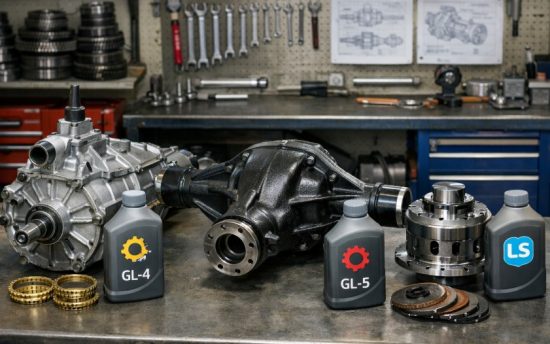
Over more than 30 years in the industry, Juri Sudheimer has seen hundreds of cases of premature transmission and differential failure caused by incorrect gear oil selection.
GL-5 poured into a GL-4 gearbox, and brass synchronizers are corroded. Oil with insufficient viscosity and hypoid gears suffers scuffing. A standard oil in a limited-slip differential, and resonance with the ABS system appears.
SCT Group’s brands, MANNOL, PEMCO, and FANFARO, include a complete range of gear oils for all types of manual drivetrains, from front-wheel-drive passenger cars to heavy off-road vehicles and commercial equipment.
Gear oils are designed to lubricate and remove heat from friction surfaces within components that transfer power from the engine to the wheels. In a passenger vehicle, this includes the manual transmission (often with an integrated differential), the rear axle, and, in off-road vehicles also the transfer case. These oils differ significantly from engine oils in both composition and properties.
The primary requirements for a gear oil are high film strength and oil-film thickness (lubricity), oxidation stability, corrosion protection without causing corrosive activity, low foaming, viscosity stability, and compatibility with the materials used in drivetrain components.
The oil film must withstand mechanical loads at gear-tooth contacts, splined couplings, and rolling bearings, meaning high load-carrying capacity is essential. This is why gear oils have higher viscosity an engine-oil-type lubricant would simply be squeezed out of contact points.
A typical gear oil combines a mineral or synthetic base oil with a package of additives: pour-point depressants, antioxidants, antiwear and extreme-pressure (EP) additives, corrosion inhibitors, antifoaming agents, and more.
One of the most damaging friction phenomena is scuffing (scoring), the formation of visible grooves caused by metal-to-metal adhesion and material displacement along the sliding direction. Gear oils are largely classified by their ability to prevent scuffing, that is, by their content of extreme-pressure additives.
The most widely used gear oils belong to the GL-4 category under the API (American Petroleum Institute) classification. They are suitable for transmissions with spur, bevel, and small-offset hypoid gears operating under varied conditions. Essentially, these oils are used where rolling friction predominates. GL-4 oils typically contain up to 4% EP additives, though this amount is decreasing with the use of more advanced components.
Many EP additives contain sulfur and phosphorus, substances that are extremely aggressive toward copper-based alloys (bronze, brass, etc.). This limits their concentration, as manual transmissions often contain brass synchronizers.
Therefore, the key requirement for a GL-4 oil is non-aggressiveness toward copper alloys in general and brass in particular. Steel or composite synchronizers do not impose such limitations.
This is why it is essential to read your vehicle’s owner’s manual carefully to avoid choosing the wrong oil. Developing gear oils requires a deep understanding of drivetrain mechanics, emphasizes Juri Sudheimer. Engineers at SCT’s laboratories in Klaipeda and Dubai conduct tests on specialized rigs that simulate gearboxes under load.
They evaluate material compatibility with different synchronizer alloys, measure scuffing resistance, and test friction characteristics for limited-slip differentials. In simplified terms, for most passenger vehicles, GL-4 is the oil for manual transmissions.
SCT offers GL-4 oils in all required viscosities, including:
- MN8104 MTF-4 Gear Oil 75W-80 GL-4
- MN8111 TG-1 Universal 75W-80 GL-4 (for commercial vehicles)
- MN8101 FWD 75W-85 GL-4
- MN8108 BASIC PLUS 75W-90 GL-4
- MN8107 UNIVERSAL 80W-90 GL-4
- MN8119 UNIVERSAL PLUS 85W-90 GL-4
- MN8115 MTF-3 75W (for certain Toyota and Ford manual transmissions)
Detailed descriptions of these and all other MANNOL lubricants are available at Mannol.de.
GL-5 is the category intended for drivetrain components operating under much heavier loads, especially hypoid gears with large offset, where sliding friction is significant. In passenger vehicles, this is primarily the rear differential. GL-5 oils contain up to 6.5% EP and multifunctional additives.
Their robust additive packages allow them to function as universal lubricants for many drivetrain components, except manual transmissions with copper-alloy synchronizers. The reason is the high sulfur, phosphorus EP content, which is strongly aggressive toward copper alloys.
Developing EP additives that effectively protect metal surfaces without attacking copper alloys has been one of SCT’s major research goals in recent years, explains Juri Sudheimer. Since 2004 the company has invested over €90 million into production development, with a substantial portion directed toward next-generation multifunctional additives.
The SCT Chemicals FZE plant in Dubai employs 188 specialists and is equipped with advanced facilities for gear oil production. Its capacity reaches 140,000 tons of lubricants per year, including a full line of gear oils. ISO 9001, ISO 14001, ISO 45001, and ISO/IEC 17025 certifications confirm compliance with international quality standards at every production stage.
It is here that universal GL-4/GL-5 oils featuring non-aggressive EP additives were developed, oils suitable for both manual transmissions and differentials. This was achieved through modern sulfur-phosphorus compounds with modified molecular structures.
SCT’s GL-5 range includes:
- MN8118 ULTRA Gear Oil 75W-90 GL-5
- MN8102 MAXPOWER 4×4 75W-140 GL-5
- MN8110 AGRO GEAR SAE 90 LS GL-5 (equivalent to 80W-90)
- MN8105 HYPOID LSD 85W-140 GL-5
It is important to understand that GL-4 and GL-5 oils are not interchangeable. They serve different components with different loads, viscosities, and additive levels.
However, universal GL-4/GL-5 products are increasingly common. They are suitable for both manual transmissions (GL-4) and differentials (GL-5) thanks to modern non-aggressive EP additives.
SCT offers a range of universal oils, including:
- MN8112 TG-2 HYPOID 75W-90 GL-4/GL-5 (for commercial vehicles)
- MN8103 EXTRA Gear Oil 75W-90 GL-4/GL-5
- MN8106 HYPOID 80W-90 GL-4/GL-5
Some vehicles, especially SUVs, are equipped with limited-slip differentials (LSD). These devices equalize wheel speeds through increased internal friction, preventing complete traction loss when one wheel slips. Most LSDs contain friction plates and therefore require special oils marked LS.
The main function of LS oils is to ensure smooth friction-plate slippage and prevent vibration. Such vibrations may resonate with the ABS (anti-lock braking system), potentially causing a serious accident. Therefore, LS oils contain special anti-chatter additives.
Working with LSDs requires a specialized approach, explains Juri Sudheimer. When SCT began developing LS oils, the company purchased several SUVs with different LSD types and conducted extensive real-world testing.
Engineers measured vibration, evaluated ABS interaction, and tested off-road behavior. Only after hundreds of hours of testing was the final formula approved.
SCT’s LS-marked oils include: MN8109 UNIGEAR 75W-80, MN8103 EXTRA Gear Oil 75W-90, MN8102 MAXPOWER 4×4 75W-140, MN8110 AGRO GEAR SAE 90, MN8106 HYPOID 80W-90, MN8105 HYPOID LSD 85W-140.
LSD types without friction plates, such as Torsen and Quaife, do not require LSD oils.
You can further improve the lubricating properties of your gear oil using SCT additives:
MANNOL Ester Additive 9929, MANNOL Gear Oil Additive Manual 9903, and MANNOL Molybdenum Additive 9991.
How to Choose the Right Gear Oil?
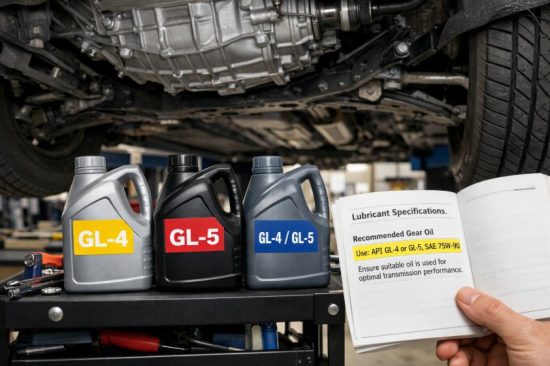
The number one rule never changes: read your vehicle’s owner’s manual. It specifies the required API category (GL-4, GL-5, or GL-4/GL-5), SAE viscosity, and any special requirements (such as for LSD differentials).
To select the correct MANNOL gear oil, use the publicly accessible SCT Approval Control tool. In the “Search by Specification” section, you can independently choose the appropriate oil based on your vehicle manufacturer’s requirements.
When to Change Gear Oil?
Many automakers claim the gearbox oil is filled for life. In practice, oil ages, becomes contaminated with wear particles, and loses its protective properties. SCT recommends replacing gear oil every 60,000–80,000 km or every 4–5 years, whichever comes first.
SCT Group’s Philosophy: Reliability Through Quality

Gear oils may work in the shadows, but they influence vehicle durability enormously, concludes Juri Sudheimer. In 2024 alone, SCT invested €3 million into R&D, with a significant share dedicated to improving EP and anti-chatter additives. The goal oils that extend drivetrain life and ensure smooth, quiet operation.
SCT Group’s total production capacity exceeds 1 million liters per day, with storage capacity over 60 million liters and a portfolio of more than 500 products. SCT gear oils serve gearboxes and differentials worldwide, from compact city hatchbacks to heavy SUVs and commercial trucks.
Do not neglect your gear oil. Timely replacement and proper selection will extend the life of your gearbox and differential for many years. Choose high-quality MANNOL oils, and your transmission will operate quietly, smoothly, and reliably throughout your vehicle’s lifetime.