
The UAE resident vehicle registration limit 2027 introduces an important change for expatriates and other individual residents who own multiple vehicles. From 1 January 2027, individual residents will be permitted to register a maximum of five vehicles, with additional registration or renewal fees applying to vehicles beyond the first two.
The changes form part of Cabinet Decision No. 174 of 2026, which establishes the Executive Regulation of Federal Decree-Law No. 14 of 2024 concerning traffic regulation.
The regulation was issued on 6 October 2026 and introduces updated requirements covering vehicle licensing, registration procedures, roadworthiness and driving assessments.
For residents planning to purchase a third, fourth or fifth vehicle, the financial implications could be significant. However, the government has not yet clarified the additional fee amounts or how the new limit will affect people who already have more than five registered vehicles.
Our analysis of the published requirements shows that residents need to distinguish between the standard two-vehicle allowance, the maximum five-vehicle registration limit and the existing requirements applied by individual emirates.
What Is the New UAE Resident Vehicle Registration Limit for 2027?
Under Article 89 of Cabinet Decision No. 174 of 2026, individual UAE residents can register up to two vehicles under the standard provision.
Residents who wish to register or renew a third, fourth or fifth vehicle must pay an additional fee for each vehicle beyond the first two.
The total number of licensed vehicles must not exceed five per individual resident.
| Vehicle registered | Rule from 1 January 2027 |
| First vehicle | Standard registration requirements |
| Second vehicle | Standard registration requirements |
| Third vehicle | Additional fee applies |
| Fourth vehicle | Additional fee applies |
| Fifth vehicle | Additional fee applies |
| Sixth vehicle | Exceeds the five-vehicle limit |
| Company vehicles | No equivalent numerical cap specified in Article 89 |
The regulation establishes a two-plus-three structure rather than allowing five vehicles without additional charges.
A particularly important distinction is that the provision concerns vehicles licensed or registered in an individual’s name. It should not automatically be interpreted as a requirement to dispose of an existing vehicle before the relevant authorities clarify transitional arrangements.
When Will the UAE Five-Vehicle Registration Rule Take Effect?

The new UAE vehicle registration limit is scheduled to take effect on 1 January 2027.
The executive regulation replaces the previous traffic executive regulation established under Ministerial Decision No. 130 of 1997, subject to the decision’s repeal provisions.
Until the new regulation takes effect, motorists must continue following their licensing authority’s existing procedures.
For example, Dubai’s Roads and Transport Authority currently states that residents can register a maximum of three vehicles, while Emirati citizens can register an unlimited number.
This existing Dubai requirement differs from the upcoming federal five-vehicle framework. Residents should therefore avoid assuming they can immediately register five vehicles before January 2027.
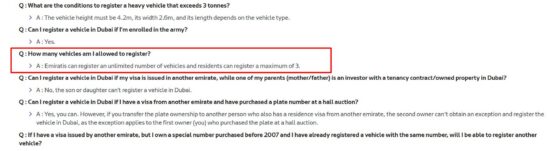
This comparison is particularly useful because it explains why residents may encounter different registration limits before and after the new federal rules are implemented.
How Much Will Residents Pay to Register More Than Two Vehicles in 2027?
One of the biggest questions surrounding the UAE resident vehicle registration limit 2027 is the cost of registering additional vehicles.
Article 89 confirms that extra fees will apply to the third, fourth and fifth registered vehicles. However, the additional fee amounts have not been specified as of 2 November 2026.
This means residents cannot yet calculate the precise additional cost of maintaining three or more vehicles under the new framework.
The final amount payable may include ordinary registration fees, vehicle inspection charges, insurance expenses and the new additional fee.
For households managing several cars, the sensible financial approach is to avoid committing to additional purchases until the relevant licensing authority publishes its fee schedule.
For example, a resident considering purchasing a fourth vehicle should calculate the annual cost of ownership, not simply the purchase price.
This includes depreciation, insurance, maintenance, parking, registration and potentially the additional 2027 licensing charge.
A vehicle used only occasionally may become less financially attractive if recurring ownership expenses increase.
Importantly, the regulation does not establish a publicly confirmed percentage increase for registration fees. Any claim that charges will rise by a specific percentage would therefore be premature.
Who Will Be Affected by the UAE Vehicle Registration Limit?
The provision specifically addresses individual residents rather than introducing the same numerical limit for every category of vehicle owner.
Its principal implications concern expatriates and other residents who maintain multiple privately registered vehicles.
Expatriate residents
Expatriates owning three or more licensed vehicles should expect the new additional-fee requirements to become relevant from January 2027.
Someone owning only one or two vehicles would not incur the specific additional charge associated with the third, fourth or fifth vehicle.
UAE citizens
Article 89’s five-vehicle provision specifically concerns individual residents. It does not establish the same numerical restriction for UAE citizens.
Dubai’s existing RTA guidance permits Emirati citizens to register an unlimited number of vehicles.
Residents should nevertheless consult updated instructions before assuming that every current distinction will continue unchanged after implementation.
Company and commercial vehicles
The provision does not specify an equivalent five-vehicle cap for companies.
This distinction matters for logistics operators, construction businesses, delivery companies and organisations maintaining corporate fleets.
However, the absence of a numerical restriction in Article 89 does not exempt commercial vehicles from other applicable licensing, insurance or roadworthiness requirements.
Businesses should ensure that vehicles are genuinely registered under the appropriate legal entity and comply with their permitted commercial activities.
For companies operating regularly across different emirates, digital registration and account management are also important. The existing Dubai vehicle licensing services integration explains the administrative changes affecting vehicle licensing services.
What Happens if a UAE Resident Already Owns More Than Five Vehicles?
The treatment of existing multi-vehicle registrations remains one of the most important unresolved questions.
Cabinet Decision No. 174 of 2026 does not clearly explain how the five-vehicle limit will be applied to residents who already have six or more licensed vehicles.
Several practical possibilities require clarification, including whether existing registrations will receive transitional arrangements and whether owners will be permitted to renew vehicles already registered before January 2027.
There is currently no confirmed general grace period for affected vehicle owners.
Consequently, residents should not assume that their existing registrations will automatically be cancelled. Equally, they should not assume that every existing vehicle can continue to be renewed indefinitely.
The most responsible preparation is to review the vehicles currently recorded in the owner’s traffic file and obtain written guidance from the relevant licensing authority before making major ownership decisions.
Vehicle transfers should represent genuine changes in ownership, with the appropriate registration and insurance documentation.
How Can Residents Register or Renew Vehicles Under the 2027 Rules?
Article 89 requires vehicle owners or their legally authorised representatives to submit licensing applications through the electronic channels announced by the competent licensing authority.
The general UAE registration process remains based on identity verification, vehicle documentation, insurance, applicable inspections and payment of fees.
According to the UAE government’s official vehicle registration guidance, the process generally involves:
- Obtain the relevant vehicle ownership or transfer documentation.
- Complete a technical inspection where required.
- Arrange valid motor insurance.
- Settle outstanding traffic fines where applicable.
- Submit the registration application through an authorised channel.
- Pay the applicable fees and obtain the vehicle registration certificate.
The services available depend on the relevant emirate and the type of transaction.
Dubai motorists commonly use RTA digital services, while other emirates provide registration services through their respective authorities and approved federal platforms.
Residents looking for practical instructions can follow the vehicle registration renewal online UAE process, including the documents and steps involved.
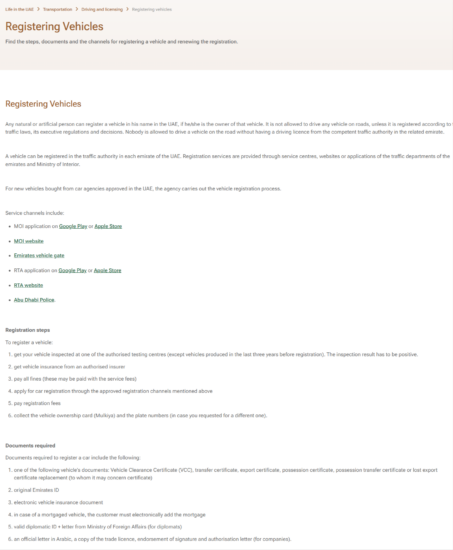
Residents should remember that successful registration is not guaranteed simply because they have fewer than five vehicles. Each vehicle must independently satisfy the applicable requirements.
What Other Vehicle Licensing Requirements Are Changing in 2027?
The new executive regulation also introduces or consolidates requirements relating to vehicle eligibility and safety.
Right-hand-drive vehicles
Article 89 prohibits the licensing of right-hand-drive vehicles while permitting them to be used for display purposes.
This matters particularly for vehicle collectors and residents considering importing cars manufactured for overseas markets.
A vehicle purchased for collection or display should not automatically be considered eligible for normal road registration.
Vehicle roadworthiness
Vehicles that fail to satisfy the prescribed safety standards are ineligible for licensing under the new regulation.
For owners of older vehicles, inspections and maintenance are therefore important considerations when assessing whether to retain additional cars.
Businesses buying second-hand vehicles should also account for inspection-related expenses before acquiring them.
Digital applications
The regulation specifically requires owners or authorised representatives to use the electronic application channels announced by the licensing authority.
Digital records can help reduce administrative errors, but owners remain responsible for ensuring that vehicle information, insurance and registration details are accurate.
Why Is the UAE Strengthening Its Traffic Regulations?
The wider traffic reforms reflect the UAE’s continued emphasis on licensing compliance and road safety.
According to Ministry of Interior figures reported by Gulf News in May 2026, 36 traffic accidents in 2025 were attributed to driving without a valid licence.
Federal Decree-Law No. 14 of 2024 also strengthened penalties for certain unlicensed driving offences.
For driving without a licence, or without a licence valid for the relevant vehicle category, the reported penalties include imprisonment of up to three months and fines ranging from AED 5,000 to AED 50,000.
Repeat offences can attract more severe penalties, including fines reaching AED 100,000.
These penalties concern driving-licence violations. They should not be confused with an automatically applicable fine for exceeding the five-vehicle registration limit, for which a specific penalty has not been identified in the published reporting.
Road safety is also relevant to vehicle registration renewal.
On 1 November 2026, The National reported that Dubai Police had recorded 48,950 violations involving expired vehicle registration during the first ten months of 2026.
Brigadier Juma Salem bin Suwaidan, Director of the General Department of Traffic at Dubai Police, emphasised the importance of vehicle inspections for identifying problems involving tyres, brakes, lighting and steering systems.
His comments reinforce an important distinction: vehicle registration is not simply an administrative payment. It is part of maintaining a vehicle’s legal and technical eligibility for road use.
Motorists can also review existing traffic compliance initiatives, including the UAE driver traffic point reduction programme.
How Do the 2027 Driving Test Rules Relate to Vehicle Registration?
The five-vehicle limit is not the only traffic-related provision scheduled to take effect in January 2027.
Cabinet Decision No. 174 of 2026 also covers driving-licence assessment requirements.
Under Articles 65 and 68, applicants must achieve a minimum score of 75% in the relevant theory and practical driving assessments.
However, achieving that score does not necessarily guarantee success in a practical test.
Dangerous driving errors or situations requiring examiner intervention may result in failure regardless of the overall score.
These rules are separate from the number of vehicles an individual can register.
A resident who already possesses a valid driving licence does not automatically need to retake a driving test simply because they register an additional vehicle.
The revised assessment provisions instead concern applicants undertaking driving-licence examinations.
How Could the Five-Vehicle Limit Affect Household and Business Costs?
The financial implications will vary depending on the number of vehicles registered, their type and how frequently they are used.
For a household maintaining two vehicles, the new additional-fee rule is unlikely to change its registration cost directly.
A household maintaining four vehicles, however, should prepare for additional charges on its third and fourth vehicles.
The wider cost calculation also matters.
| Expense | Financial consideration |
| Vehicle registration | Standard fees plus applicable additional charges |
| Insurance | Separate cover generally required for each vehicle |
| Vehicle inspection | Depends on age and applicable licensing requirements |
| Maintenance | Increases with fleet size and vehicle condition |
| Parking | Depends on location, space and applicable tariffs |
| Toll charges | Depend on use of chargeable routes |
Residents maintaining several vehicles in Dubai should also consider how to pay for parking in Dubai, including applicable parking fees and payment methods.
For residents frequently driving in Abu Dhabi, Abu Dhabi toll registration is another separate administrative requirement.
Neither parking permits nor toll accounts should be confused with the five-vehicle licensing limit.
For business owners, the more substantial issue is ensuring that private and company vehicles are correctly registered, insured and used for their intended purposes.
What Should Residents Do Before January 2027?
Residents owning multiple vehicles should review their position before the new requirements take effect.
The most useful preparations include:
- Check existing registrations: Confirm the number of licensed vehicles recorded in your name.
- Review renewal dates: Identify registrations expiring around January 2027.
- Verify registration eligibility: Contact the relevant authority if you currently exceed its permitted limit.
- Budget for extra fees: Allow for additional charges without assuming an unannounced amount.
- Check roadworthiness: Complete necessary maintenance and inspections.
- Review purchasing plans: Avoid basing a vehicle purchase on unresolved exemptions or transitional arrangements.
Residents should also monitor further announcements explaining how the federal regulation will interact with existing emirate-level registration services.
For owners currently holding more than five vehicles, official clarification is particularly important before cancelling registrations or transferring ownership.
FAQs About the UAE Vehicle Registration Limit 2027
How many cars can a UAE resident register in 2027?
Under the new federal framework, an individual resident can register a maximum of five vehicles, with additional fees applying to the third, fourth and fifth vehicles.
Is there an extra registration fee for a third car in the UAE?
Yes. Article 89 establishes an additional fee for vehicles registered or renewed beyond the first two. The exact amount has not yet been specified.
Does the five-vehicle limit apply to UAE companies?
Article 89 does not establish an equivalent numerical limit for companies. Commercial vehicles remain subject to other applicable licensing and safety requirements.
Can a resident keep six cars registered after January 2027?
The regulation establishes a maximum of five licensed vehicles for individual residents, but transitional arrangements for owners already exceeding this number have not been clarified.
Do Golden Visa holders receive an exemption?
No special exemption from the new five-vehicle provision has been confirmed. Dubai’s existing registration guidance also states that Golden Visa holders must comply with standard individual registration requirements.
Will residents have to sell their vehicles before January 2027?
No automatic requirement to sell existing vehicles has been confirmed in the published details. Owners exceeding the limit should seek clarification from their licensing authority.