
Last Update – 23-10-2026
Choosing the best personal loan in the UAE involves more than finding a bank advertising a low interest rate. The amount you can borrow, your monthly salary, employment status, credit history, salary-transfer arrangements and repayment obligations all influence the final offer.
A personal loan can help finance education, home improvements, medical expenses, major family commitments or the consolidation of expensive existing debt.
However, differences in interest calculations, processing fees and eligibility requirements can make seemingly similar loans significantly different in cost.
The UAE personal lending market has also changed. In November 2025, the Central Bank of the UAE removed the previously applied AED 5,000 minimum salary requirement, allowing financial institutions to determine their own eligibility thresholds.
Individual banks can still require salaries of AED 5,000, AED 7,500, AED 15,000 or more for particular products.
For borrowers, this means that qualifying for a loan is not simply about meeting a universal salary figure.
This guide compares 12 personal-loan providers in the UAE, including conventional and Islamic financing options. It examines advertised rates, salary requirements, loan amounts, repayment terms and the additional costs borrowers should consider before applying.
Updated: 22 October 2026. Rates and promotional terms can change. All applications are subject to the lender’s assessment and approval.
What Is a Personal Loan in the UAE?
A personal loan is a financing arrangement under which a bank or licensed financial institution provides an approved sum of money to an individual, usually repayable through monthly instalments.
Most conventional personal loans in the UAE are unsecured, meaning borrowers generally do not need to pledge property or another asset as collateral.
However, banks still evaluate the applicant’s ability to repay using salary information, employment details, existing financial commitments and credit bureau records.
Islamic banks offer personal finance through Shariah-compliant arrangements such as Murabaha or other approved contracts, with profit charges rather than conventional interest.
Personal loans are commonly used for:
- Education and university expenses.
- Medical treatment and unexpected family costs.
- Home improvements and furnishings.
- Weddings and other major personal expenses.
- Consolidating high-interest credit card balances.
- Relocation and certain overseas financial commitments.
- Other permitted personal expenses.
Personal borrowing should not automatically be treated as a substitute for business finance. Entrepreneurs seeking funds for company operations should compare business lending products, which have different eligibility, documentation and regulatory considerations.
Best Personal Loans in UAE: Quick Comparison of 12 Banks
The following comparison highlights the providers worth considering based on their published features and suitability for different borrowing needs.
| Bank | Advertised rate or pricing | Published minimum salary | Suitable for |
| Emirates NBD | From 4.99% reducing p.a. | Confirm with bank | Large loans and established salaried borrowers |
| First Abu Dhabi Bank (FAB) | From 4.79% fixed p.a. for eligible UAE nationals; 5.74% for eligible expats | AED 7,000 | Large loan amounts and salary-transfer packages |
| ADCB | From 5.99% p.a. for expats | AED 5,000 | Salaried expatriates |
| Mashreq | Personalised reducing rates | AED 5,000 for approved employers; AED 8,000 for unapproved employers | Digital banking and flexible employer eligibility |
| RAKBANK | From 5.35% reducing p.a. on its checked personal-loan page | Product-dependent | Loan transfers and conventional borrowing |
| Commercial Bank of Dubai (CBD) | From 5.50% reducing p.a. on its published product information | AED 8,000 | Debt buyouts and existing-loan top-ups |
| Dubai Islamic Bank (DIB) | Profit rate subject to quotation | Product-dependent | Islamic personal finance |
| Abu Dhabi Islamic Bank (ADIB) | Profit rate subject to quotation | AED 5,000 | Shariah-compliant finance |
| Emirates Islamic | From 2.59% flat p.a. for UAE nationals; 2.99% flat for expats | AED 7,500 on current product page | Competitive Islamic finance |
| HSBC UAE | 7% representative APR for specified Premier customers | AED 7,500 or AED 12,500 depending on employer | Premier banking and transparent APR illustrations |
| Sharjah Islamic Bank (SIB) | Profit rate subject to quotation | AED 5,000 | Islamic finance and liability takeovers |
| Commercial Bank International (CBI) | Individually determined rates | AED 15,000 | Higher-income salaried borrowers |
Important: These rates are not ranked from cheapest to most expensive because banks use different quoting methods. A 2.59% flat profit rate cannot be directly compared with a 5.35% reducing-balance interest rate. An individually issued Key Facts Statement is required for a reliable comparison.
Top 12 Best Personal Loans in UAE for 2026
1. Emirates NBD Personal Loan

Emirates NBD is a major option for UAE nationals and expatriates seeking conventional personal finance, particularly borrowers who need a substantial loan and want a structured repayment arrangement.
Its published Key Facts Statement lists personal loans of up to AED 4 million for UAE nationals and AED 2 million for expatriates, subject to regulatory and individual eligibility limits.
The bank’s fixed-rate personal loan offers indicative interest rates starting from 4.99% per annum on a reducing-balance basis. Its published APR range begins at 5.48%, reflecting applicable borrowing costs.
A significant benefit is the availability of both fixed and variable-rate arrangements, allowing eligible borrowers to compare repayment certainty against products linked to market interest rates.
Emirates NBD also offers a separate non-salary-transfer loan through its Priority Banking proposition. That product advertises borrowing of up to AED 500,000 and rates starting from 8.99% reducing per annum.
Borrowers should distinguish between the conventional salary-transfer product and the more expensive non-transfer option rather than assuming the same advertised rate applies to both.
| Feature | Details |
| Maximum advertised loan | AED 4 million for nationals; AED 2 million for expats |
| Starting indicative fixed interest | 4.99% reducing p.a. |
| Indicative starting APR | 5.48% |
| Repayment period | 12–48 months |
| Processing fee | 1.05%, minimum AED 525 and maximum AED 2,625, including VAT |
| Salary transfer | Depends on selected product |
| Rate type | Fixed and variable options |
What borrowers should consider: The attractive starting rate is not necessarily the rate offered after the bank evaluates employment stability, existing debt and credit history. Customers should compare both the final interest rate and APR before signing.
2. First Abu Dhabi Bank (FAB) Personal Loan

First Abu Dhabi Bank provides several personal-loan products covering salaried residents, UAE nationals and selected employees of non-listed companies.
Its standard personal-loan offering advertises financing of up to AED 5 million for eligible UAE nationals and AED 2 million for expatriates.
FAB publishes a starting fixed annual interest rate of 4.79% for eligible UAE nationals and 5.74% for eligible expatriates who meet the conditions of its multiproduct package.
Those conditions include transferring salary to FAB and holding a FAB credit card. Borrowers choosing a salary-transfer package without the credit card may receive a different rate.
One distinctive feature is the option to delay the first instalment. FAB advertises a grace period of up to 365 days for eligible UAE nationals and up to 120 days for expatriates, depending on the arrangement.
Although payment flexibility can be useful, borrowers must check whether the grace period increases total borrowing costs.
FAB also offers a non-listed-company personal loan for applicants whose employers are not on its standard approved list.
| Feature | Details |
| Maximum advertised loan | AED 5 million for nationals; AED 2 million for expats |
| Starting rates | 4.79% nationals; 5.74% expats under qualifying package conditions |
| Standard minimum salary | AED 7,000 |
| Non-listed-company product | Minimum salary AED 10,000 |
| Standard tenure | Up to 48 months |
| Processing fee | 1.05%, subject to published minimum and maximum charges |
| Additional features | Buyouts, top-ups and first-instalment grace periods |
FAB also announced a paperless personal-loan journey in August 2026 for eligible customers in the FAHR-integrated employer network. Employment and salary information can be retrieved digitally, reducing manual documentation.
What borrowers should consider: A delayed first instalment provides temporary cash-flow relief, not a reduction in the amount owed. Request an amortisation schedule showing the complete repayment cost, including insurance and any deferred interest.
Apply Now At First Abu Dhabi Bank →
3. ADCB Personal Loan

Abu Dhabi Commercial Bank offers personal loans to UAE nationals and expatriates earning regular salaries from eligible employers.
For expatriates, ADCB advertises interest rates starting from 5.99% per annum, with the final pricing determined by the individual application.
Its personal-loan products can be suitable for borrowers who want a traditional salary-transfer arrangement combined with digital account management.
ADCB specifies a minimum fixed monthly salary of AED 5,000. Applicants must generally be at least 21 years old and employed by an organisation that is already listed with the bank or qualifies for listing.
The bank requires salary transfer into an ADCB account for the standard personal-loan facility.
Existing customers may also be eligible for instant personal-loan facilities through the ADCB Mobile Banking App.
| Feature | Details |
| Expatriate advertised starting rate | 5.99% p.a. |
| Minimum salary | AED 5,000 |
| Maximum advertised amount | AED 4 million for nationals; AED 1.5 million for expats |
| Repayment term | 6–48 months |
| Salary transfer | Required for standard personal loan |
| Processing fee | 1.05% of loan amount |
| Minimum application age | 21 |
ADCB’s published illustration shows that a loan of AED 100,000 at 7.25% over 48 months would have a monthly instalment of approximately AED 2,420.78, excluding the separate processing fee.
What borrowers should consider: ADCB’s salary and employer eligibility rules make it important to verify whether your company is approved before completing a full application.
4. Mashreq Personal Loan

Mashreq offers conventional personal loans alongside digital borrowing products designed for customers with different financing requirements.
Its standard personal loan is available to qualifying salaried customers and generally requires salary transfer to Mashreq.
The published minimum salary is AED 5,000 for employees of approved companies and AED 8,000 for employees of unapproved companies.
Mashreq also caters to certain customers who are new to the UAE or have recently joined an employer, subject to its specific lending criteria.
A particularly useful alternative is Mashreq NEO Credit, a digital lending product that does not require salary transfer.
NEO Credit advertises loan amounts of up to AED 150,000, repayment periods of two to 48 months, and personalised annual rates ranging from 9.49% to 26.49%.
This makes it an option for convenience-focused borrowers, although the upper end of its pricing range can be significantly more expensive than traditional salary-transfer borrowing.
| Feature | Standard Mashreq Personal Loan |
| Maximum loan | Up to AED 2 million, subject to eligibility |
| Minimum salary, approved employer | AED 5,000 |
| Minimum salary, unapproved employer | AED 8,000 |
| Repayment period | Generally 6–48 months |
| Interest | Reducing-balance rate determined individually |
| Salary transfer | Required |
| Additional products | NEO Credit and selected new-to-employment options |
Mashreq’s standard personal loan and NEO Credit should be compared as different products, not interchangeable versions of one offer.
What borrowers should consider: When comparing digital loans, avoid focusing solely on application speed. A convenient application can still carry a higher APR, making the total repayment amount the more important financial measure.
5. RAKBANK Personal Loan

RAKBANK is worth considering for borrowers looking for conventional personal lending, loan takeovers and refinancing opportunities.
Its standard personal-loan page advertises reducing-balance interest rates starting from approximately 5.35% per annum at the time checked, although the bank has also advertised different promotional starting rates.
The product provides repayment options of up to 48 months for expatriates, subject to approval.
RAKBANK highlights facilities for moving an existing personal loan from another bank and topping up an existing loan.
These features may be useful when a borrower has an expensive current loan and qualifies for a cheaper refinancing arrangement.
However, refinancing only makes financial sense when the savings on future interest exceed any settlement fees, processing charges and additional costs.
| Feature | Details |
| Advertised interest | Starting rate subject to the current product offer |
| Rate calculation | Reducing balance |
| Repayment term for expats | Up to 48 months |
| Loan buyout | Available |
| Existing-loan top-up | Available subject to approval |
| Salary requirement | Depends on loan product and customer profile |
| Separate non-transfer cash loan | Advertised from 12.99% reducing p.a. |
RAKBANK’s non-salary-transfer cash loan is a separate facility and should not be confused with its regular personal loan.
What borrowers should consider: Ask RAKBANK for the final interest rate, APR and any repayment conditions linked to salary credits. Some loan agreements may impose additional costs if the required salary transfer stops or drops below the agreed threshold.
6. Commercial Bank of Dubai (CBD) Personal Loan

Commercial Bank of Dubai provides personal-loan options for salaried UAE nationals and expatriates, with particular emphasis on flexible repayment arrangements and existing-loan transfers.
Its published product information advertises reducing-balance interest rates starting from 5.50% per annum, although final pricing depends on CBD’s credit assessment.
The bank generally requires a minimum monthly salary of AED 8,000 and employment with an approved organisation or an employer that satisfies its approval process.
CBD offers a standard personal loan, debt buyout facilities and the possibility of topping up an existing loan.
The bank also offers a separate Quick Loan product, which may provide up to AED 150,000 without salary transfer, subject to individual eligibility.
| Feature | Details |
| Starting published rate | 5.50% reducing p.a. on product information |
| Minimum salary | AED 8,000 |
| Standard repayment period | Up to 48 months |
| Salary transfer | Required for standard loan |
| Processing fee | 1% plus applicable VAT, subject to limits |
| Existing-loan buyout | Available |
| Additional option | CBD Quick Loan without salary transfer |
CBD is particularly relevant for borrowers investigating debt restructuring because of its loan-buyout services.
However, borrowers should distinguish between reducing their monthly instalment and reducing the total borrowing cost.
Extending the repayment period may make instalments more manageable while increasing cumulative interest.
What borrowers should consider: Request a full comparison of the existing loan’s remaining repayments against CBD’s proposed loan, including early settlement fees, processing charges and any insurance requirements.
Apply Now At Commercial Bank of Dubai→
7. Dubai Islamic Bank (DIB) Personal Finance
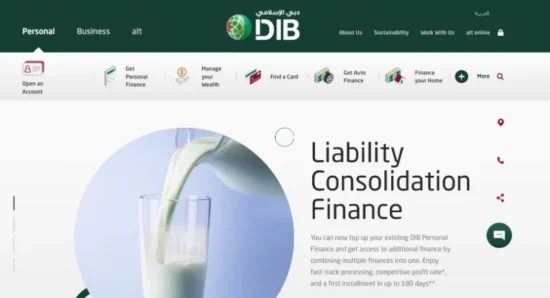
Dubai Islamic Bank offers Shariah-compliant personal-finance facilities for eligible UAE nationals and residents.
Instead of conventional interest-based lending, its personal-finance arrangements follow approved Islamic financial structures.
The bank advertises financing of up to AED 5 million for eligible customers, with the actual amount depending on income, employment and applicable regulatory limits.
DIB also promotes flexible first-instalment arrangements, including a grace period of up to 240 days for eligible UAE nationals.
These arrangements can be particularly useful for borrowers who prefer Islamic finance and want to understand the profit amount agreed under the financing contract.
| Feature | Details |
| Financing type | Shariah-compliant personal finance |
| Maximum advertised financing | Up to AED 5 million |
| Profit rate | Individually quoted |
| Standard repayment period | Generally up to 48 months |
| First-instalment flexibility | Up to 240 days for eligible UAE nationals |
| Salary requirement | Confirm for selected product |
| Application method | Online application or callback |
Islamic finance should be assessed using the total amount payable, documentation charges, any Takaful costs and the treatment of early settlement.
A lower advertised profit rate does not automatically mean a cheaper product unless the rate calculations are directly comparable.
What borrowers should consider: Ask for the complete repayment schedule and the applicable Shariah contract. Clarify how the bank calculates outstanding profit and any rebate or charge if the finance is settled early.
Apply Now At Dubai Islamic Bank →
8. Abu Dhabi Islamic Bank (ADIB) Personal Finance

Abu Dhabi Islamic Bank provides Islamic personal finance to UAE nationals and eligible expatriate residents.
Its personal-finance products offer funding of up to AED 3 million for UAE nationals and AED 2 million for expatriates, subject to affordability and eligibility.
ADIB publishes a minimum monthly salary requirement of AED 5,000 and a minimum application age of 21 years.
Eligible customers can repay financing over periods of up to 48 months.
The bank also advertises a grace period of up to seven months before the first instalment, along with the possibility of postponing instalments subject to product conditions.
Optional Takaful coverage is available.
| Feature | Details |
| Maximum financing, UAE nationals | AED 3 million |
| Maximum financing, expatriates | AED 2 million |
| Minimum salary | AED 5,000 |
| Repayment tenure | Up to 48 months |
| Profit rate | Individually determined |
| First-instalment grace period | Up to seven months |
| Takaful | Optional coverage available |
ADIB’s financing may appeal to customers who want Shariah-compliant borrowing with flexible repayment features.
However, postponing instalments should be evaluated carefully because it may alter the payment schedule or overall financing obligations.
What borrowers should consider: Verify whether Takaful is optional for the specific offer and obtain a written breakdown of all profit, documentation and protection costs.
Apply Now At Abu Dhabi Islamic Bank →
9. Emirates Islamic Personal Finance

Emirates Islamic provides Murabaha-based personal finance to eligible UAE nationals and expatriates.
The bank currently advertises flat annual profit rates starting from 2.59% for UAE nationals and 2.99% for expatriates on its main personal-finance page.
It also displays corresponding approximate reducing rates of 4.74% and 5.47%, respectively.
This is a particularly useful disclosure because it makes clear that a low flat profit-rate figure should not be compared directly with another bank’s reducing-balance rate.
Emirates Islamic advertises financing of up to AED 4 million for UAE nationals and AED 3 million for expatriates.
The current main product page lists a minimum salary of AED 7,500. Some older help information displays a lower figure, making confirmation of the applicable product conditions important.
| Feature | Details |
| Starting flat profit, UAE nationals | 2.59% p.a. |
| Approximate reducing equivalent | 4.74% p.a. |
| Starting flat profit, expats | 2.99% p.a. |
| Approximate reducing equivalent | 5.47% p.a. |
| Minimum salary on main product page | AED 7,500 |
| Maximum advertised finance | AED 4 million nationals; AED 3 million expats |
| Standard tenure | Up to 48 months |
| Financing structure | Shariah-compliant Murabaha |
A separate promotional offer valid until 31 October 2026 advertises a 2.49% starting flat rate for eligible UAE nationals, but eligibility conditions include high salary requirements. Such promotions should not be treated as universally available.
What borrowers should consider: Emirates Islamic is worth including in a cost comparison, particularly for applicants seeking Islamic finance. Ask for the final reducing-equivalent rate, APR where provided, and complete total payable.
Apply Now At Emirates Islamic →
10. HSBC UAE Personal Loan
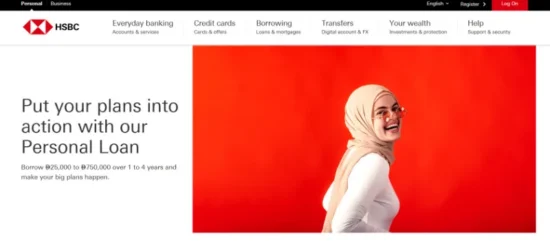
HSBC offers personal loans for eligible UAE residents and nationals, with interest rates determined according to customer profile and banking relationship.
The bank publishes a representative APR of 7% for a specified HSBC Premier customer employed by an approved company and transferring salary to HSBC.
This is a representative example, not an automatic offer for every borrower.
HSBC’s personal-loan calculator covers borrowing amounts from AED 25,000 to AED 750,000 over periods of 12 to 48 months.
A notable feature is that HSBC states additional credit-life insurance is not required for its standard personal loan.
For borrowers comparing competing bank offers, this may simplify the assessment of mandatory add-on costs.
| Feature | Details |
| Representative APR | 7% for specified Premier customer profile |
| Loan range illustrated | AED 25,000–750,000 |
| Repayment period | 12–48 months |
| Minimum salary, approved employer | AED 7,500 |
| Minimum salary, other applicants | AED 12,500 |
| Salary transfer | Required |
| Additional credit-life insurance | Not required |
HSBC provides an illustrative AED 150,000 loan over 48 months, showing a monthly instalment of AED 3,574.56 and processing fees of AED 1,575, including VAT.
What borrowers should consider: HSBC’s APR disclosure makes comparison easier, but its salary-transfer and employer conditions must be satisfied. The representative rate should not be interpreted as a guaranteed quote.
11. Sharjah Islamic Bank (SIB) Personal Finance
Sharjah Islamic Bank provides Shariah-compliant personal finance to eligible UAE nationals and expatriates.
Its facilities include new personal financing, additional finance and takeovers of existing financial obligations.
The bank’s published minimum salary requirement is AED 5,000, with applicants generally required to transfer salary to SIB and work for an employer included on its approved list.
SIB also offers specialised financing arrangements related to medical expenses, travel and rental commitments.
| Feature | Details |
| Financing type | Shariah-compliant personal finance |
| Minimum salary | AED 5,000 |
| Salary transfer | Required |
| Employer eligibility | Approved employer list applies |
| Standard tenure | 6–48 months |
| Advertised maximum, expatriates | AED 1.2 million in published FAQ |
| Advertised maximum, UAE nationals | AED 2.5 million in published FAQ |
| Additional facilities | Liability takeover and selected purpose-specific finance |
The bank’s published personal-finance FAQs indicate a documentation fee of 1% before applicable taxes and charges, subject to stated minimum and maximum amounts.
SIB is a useful comparison option for borrowers who want Islamic finance without automatically choosing one of the larger banks.
What borrowers should consider: Employer-list eligibility is an important preliminary check. Applicants should also request details of the profit calculation, documentation fees, early settlement arrangements and any Takaful costs.
Apply Now At Sharjah Islamic Bank →
12. Commercial Bank International (CBI) Personal Loan
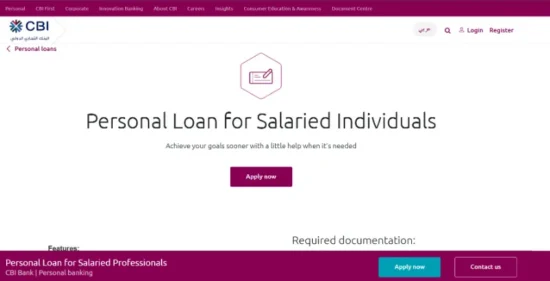
Commercial Bank International offers personal loans to eligible UAE nationals and expatriates who transfer their salaries to the bank.
CBI’s minimum monthly salary requirement is AED 15,000, positioning its standard personal loan primarily towards middle- and higher-income salaried applicants.
The bank offers financing of up to 20 times the applicant’s salary, subject to regulatory and credit limits.
Its public product information states that the maximum loan amount is AED 1 million, while the bank’s more detailed 2026 Key Facts Statement distinguishes limits by borrower category and secured or unsecured borrowing.
The latest applicable Key Facts Statement should therefore take precedence when determining the maximum amount available to a particular applicant.
| Feature | Details |
| Minimum salary | AED 15,000 |
| Maximum standard tenure | 48 months |
| Maximum amount | Product and customer dependent |
| Salary transfer | Mandatory |
| Minimum age | 21 years |
| Employment history | Generally three months for nationals and six months for expatriates |
| Interest rate | Determined by the customer’s financing assessment |
CBI also supports existing-loan buyouts and top-up arrangements, subject to approval.
What borrowers should consider: Applicants should request an updated written quotation rather than relying on historical website interest-rate illustrations. The final offer should specify whether pricing is fixed, variable or a combination of both.
Apply Now At Commercial Bank International→
Which Personal Loan in UAE Is Best for Your Situation?
The best lender depends on the applicant’s income, employment and financial needs rather than the bank’s brand or advertised starting rate.
| Borrower requirement | Providers worth comparing |
| Salary around AED 5,000 | ADCB, ADIB, Mashreq and SIB |
| Islamic personal finance | Emirates Islamic, ADIB, DIB and SIB |
| Large advertised borrowing limits | FAB, Emirates NBD and Emirates Islamic |
| Existing-loan refinancing | CBD, RAKBANK and Mashreq |
| No salary transfer | Mashreq NEO Credit, CBD Quick Loan and eligible Emirates NBD non-transfer products |
| Approved employer with moderate salary | ADCB, Mashreq and FAB |
| Higher-income salaried applicant | HSBC Premier and CBI |
| Digital application preference | Mashreq NEO Credit, CBD Quick Loan and eligible ADCB customers |
This table identifies relevant products to investigate, not guaranteed approvals or universally cheapest offers.
What Is the Minimum Salary for a Personal Loan in UAE in 2026?
One of the most important developments in the UAE lending market was the removal of the previously applied AED 5,000 minimum salary threshold.
The change was reported on 18 November 2025 following instructions issued to banks by the Central Bank of the UAE.
Financial institutions were given greater flexibility to determine minimum salary requirements based on their own lending policies and risk assessments.
This does not mean every employee can automatically obtain a personal loan.
Banks can still require minimum income levels, acceptable employment records and satisfactory credit bureau results.
For instance, a customer earning AED 4,000 per month may be considered for selected lending products where permitted by the bank’s criteria, but the conventional products in this comparison generally publish higher minimum salaries.
Faizan Mandavia, founder and Group CEO of FAM Group, explained in comments published by Gulf News in November 2025 that removing the salary requirement could encourage financial institutions to introduce micro-loans and entry-level credit products.
That observation helps explain the market opportunity created by the regulatory change, but broader eligibility does not mean approval standards or consumer-protection rules have disappeared.
Applicants with lower salaries should therefore check product-specific criteria rather than assuming all traditional personal loans are now available without an income threshold.
How Much Personal Loan Can You Get in the UAE?
The Central Bank of the UAE generally limits the principal amount of a personal consumer loan to 20 times the borrower’s monthly salary or verified income.
Personal loans ordinarily must be repaid within 48 months.
Another significant rule is the debt-burden ratio, which generally limits total monthly credit repayments to 50% of gross income.
These are regulatory ceilings, not guaranteed borrowing entitlements.
Example: Personal Loan Eligibility by Salary
| Monthly salary | Maximum theoretical loan at 20× income | General 50% monthly debt ceiling |
| AED 5,000 | AED 100,000 | AED 2,500 |
| AED 7,000 | AED 140,000 | AED 3,500 |
| AED 10,000 | AED 200,000 | AED 5,000 |
| AED 12,000 | AED 240,000 | AED 6,000 |
| AED 15,000 | AED 300,000 | AED 7,500 |
| AED 20,000 | AED 400,000 | AED 10,000 |
| AED 30,000 | AED 600,000 | AED 15,000 |
These figures are mathematical illustrations of regulatory limits. They do not indicate that any specific bank will approve the amount.
Consider someone earning AED 12,000 monthly who already pays AED 2,400 towards a car loan and other credit commitments.
The general debt-burden ceiling is AED 6,000.
After existing commitments, the theoretical amount available for another monthly instalment is AED 3,600.
However, this does not guarantee approval of a new loan with an AED 3,600 instalment. Banks must also assess household expenses, employment stability and the borrower’s capacity to meet repayments without hardship.
Readers can review the Central Bank’s personal-loan regulations for the governing framework.
Personal Loan Interest Rates in UAE: Flat Rate vs Reducing Balance
One of the biggest mistakes applicants make is comparing two advertised percentages without checking how each is calculated.
Banks may describe borrowing costs using flat interest rates, reducing-balance rates or annual percentage rates.
These measures are not directly interchangeable.
Flat Interest Rate
A flat rate is calculated using the original borrowed amount throughout the financing period.
For example, a loan of AED 100,000 at a 4% annual flat rate over four years would produce:
- Original borrowing: AED 100,000.
- Annual flat rate: 4%.
- Total flat interest over four years: AED 16,000.
- Total repayments: AED 116,000.
- Monthly instalment: Approximately AED 2,416.67.
The calculation is based on the full original loan amount rather than the progressively declining outstanding principal.
Reducing-Balance Interest Rate
A reducing-balance rate applies interest to the remaining principal.
As the borrower repays the loan, the outstanding balance decreases and the interest component of each instalment generally becomes smaller.
Consider a loan of AED 100,000 at a fixed 7% annual reducing rate over 48 months.
| Calculation | Result |
| Loan amount | AED 100,000 |
| Annual reducing rate | 7% |
| Tenure | 48 months |
| Monthly instalment | Approximately AED 2,394.62 |
| Total interest | Approximately AED 14,941.97 |
| Total repayment | Approximately AED 114,941.97 |
Illustrative calculations assume standard monthly amortisation and exclude processing fees, insurance and other charges.
The comparison demonstrates why a loan advertised at 4% flat can cost more than a loan advertised at 7% reducing over the same period.
Ambareen Musa, founder and former chief executive of Souqalmal.com, addressed this issue in financial advice published by The National.
She explained that borrowers cannot properly compare advertised borrowing rates unless the calculation methods are equivalent.
That remains one of the most useful principles for comparing UAE personal loans.
Before applying, request the following information from every lender:
- The annual reducing-balance interest or profit rate.
- The APR or applicable equivalent cost measure.
- The monthly instalment.
- The total financing cost.
- The total amount repayable, including compulsory charges.
A written comparison is more reliable than relying on an advertised headline percentage.
How Does Loan Tenure Affect Monthly Repayments?
A longer repayment period normally reduces the monthly instalment but increases the total interest paid.
For example, consider borrowing AED 100,000 at a fixed annual reducing rate of 7%.
| Repayment period | Approximate monthly EMI | Approximate total interest |
| 24 months | AED 4,477.26 | AED 7,454 |
| 36 months | AED 3,087.71 | AED 11,158 |
| 48 months | AED 2,394.62 | AED 14,942 |
The 48-month arrangement has the smallest monthly instalment but results in nearly twice the total interest of the 24-month arrangement.
A borrower who can comfortably afford the shorter term may therefore reduce borrowing costs significantly.
However, choosing an aggressive repayment schedule that leaves no financial buffer can increase the risk of missed payments.
A suitable loan term balances total cost against genuine monthly affordability.
What Fees Do UAE Personal Loans Include?
Interest or profit is only one element of the total borrowing cost.
Banks may charge processing fees, documentation fees, protection costs and penalties in particular circumstances.
| Charge | What borrowers should check |
| Processing fee | Percentage of loan amount, minimum and maximum charges |
| VAT | Whether applicable VAT is already included in the quoted fee |
| Credit-life insurance | Whether coverage is required and how premiums are calculated |
| Takaful | Whether Islamic finance protection is compulsory or optional |
| Early settlement | Fee for paying off the loan before maturity |
| Partial prepayment | Charge for making additional principal repayments |
| Instalment postponement | Fee and effect on total repayment |
| Late payment | Contractual charges and possible credit consequences |
| Loan buyout | Old loan settlement costs and new lender processing fees |
For example, a processing charge of 1% on an AED 100,000 loan equals AED 1,000 before applicable VAT.
With 5% VAT on that fee, the total becomes AED 1,050.
The borrower should also determine whether the fee is deducted from the funds disbursed or collected separately.
Can You Settle a Personal Loan Early?
Yes, UAE banks generally allow early settlement subject to the relevant contract and regulatory requirements.
The Central Bank’s consumer-loan fee schedule sets an early settlement charge of 1%, subject to a maximum of AED 10,000 before applicable VAT, for the relevant settlement categories.
For example, an outstanding principal balance of AED 50,000 would produce an illustrative 1% fee of AED 500 before applicable VAT.
Borrowers should still request a formal settlement quotation because the amount payable may include outstanding accrued interest or profit and other legitimate contractual sums.
The cost of settling the existing loan should also be included when evaluating refinancing.
Is It Better to Take a Personal Loan or Use a Credit Card?
The answer depends on the amount required, repayment period and whether the credit card balance can be cleared before interest becomes payable.
Credit cards offer convenience, ongoing access to credit and potentially valuable rewards.
However, carrying a revolving balance for an extended period can become expensive.
A structured personal loan may provide lower borrowing costs when replacing high-interest revolving credit, although this depends on the actual rates and fees.
| Feature | Personal loan | Credit card |
| Repayment structure | Fixed term and scheduled instalments | Revolving credit with minimum repayments |
| Borrowing purpose | Larger planned or exceptional expenses | Purchases and short-term spending |
| Interest or profit | Based on agreed loan arrangement | Applies to unpaid balances under card terms |
| Repayment discipline | Fixed repayment schedule | Greater flexibility but risk of prolonged debt |
| Additional costs | Processing and settlement charges | Annual fees, finance charges and possible cash advance fees |
| Best suited to | Structured borrowing with a repayment plan | Spending that can be repaid in full |
Borrowers who can consistently repay their full credit-card statement may avoid purchase interest, subject to their card’s terms.
For readers considering card borrowing instead, comparing the best cashback credit cards in the UAE may be useful, but rewards should never justify carrying expensive debt.
Similarly, strategies to manage credit card spending and rewards can help borrowers avoid creating additional debt after consolidating existing balances.
Can You Get a Personal Loan in UAE Without Salary Transfer?
Yes, certain UAE banks offer personal loans or alternative cash-loan facilities without requiring customers to transfer their monthly salary.
However, these arrangements often have different loan limits, pricing and eligibility conditions.
Examples include:
| Provider | Non-salary-transfer option | Published feature |
| Mashreq | NEO Credit | Up to AED 150,000 |
| CBD | CBD Quick Loan | Up to AED 150,000 |
| Emirates NBD | Eligible Priority Banking non-transfer loan | Up to AED 500,000 |
| RAKBANK | Cash Loan | Advertised from 12.99% reducing p.a. |
Borrowers should not assume that the standard personal-loan rates in the earlier comparison table apply to these products.
Non-salary-transfer lending can be more expensive because the bank does not necessarily receive the borrower’s monthly income into its own accounts.
For customers considering a salary-transfer loan, understanding how to open a bank account in the UAE can also help with the administrative process, although account-opening rules differ between providers.
Before changing banks, applicants should check whether an existing loan, credit card or salary-assignment commitment restricts the transfer.
Can Self-Employed People Get Personal Loans in the UAE?
Self-employed applicants, business owners and independent professionals may qualify for selected lending products, but their applications can involve different assessments from those of salaried employees.
Some banks offer specialist facilities or evaluate other verifiable regular income.
Rather than relying on a salary certificate, a self-employed applicant may need to provide:
- Valid Emirates ID and UAE residency documentation.
- Trade licence or professional authorisation.
- Personal and business bank statements.
- Evidence of regular income.
- Business operating history.
- Existing borrowing information.
- Additional documents requested by the lender.
For example, Emirates NBD describes eligibility conditions for selected self-employed professionals under its Priority Banking arrangements, including minimum business history and account-balance requirements.
A personal loan should not be assumed suitable for business operating expenses.
Company owners planning to purchase inventory, hire employees or expand operations should compare dedicated business-finance facilities before relying on personally repayable debt.
Does Your AECB Credit Score Affect Personal Loan Approval?
Yes. Al Etihad Credit Bureau (AECB) credit information plays an important role in UAE personal-loan assessments.
Banks use credit reports alongside salary, employment and existing debt information when determining eligibility and pricing.
AECB scores generally range from 300 to 900, with higher scores indicating a more favourable credit-risk profile.
However, there is no universally applicable AECB score that guarantees a personal-loan approval across all UAE banks.
Different lenders may apply their own risk thresholds.
Borrowers can improve the quality of their applications by paying existing commitments on time, checking reports for errors and avoiding unnecessary simultaneous loan applications.
Understanding how to check your UAE credit score can be a useful starting point.
It is also important to understand how AECB credit scores influence borrowing decisions before approaching multiple lenders.
Why Can Two People With the Same Salary Receive Different Loan Offers?
Monthly income does not reveal the borrower’s entire credit risk.
Banks also evaluate:
- Existing loan and credit card obligations.
- Repayment history.
- Employer stability and approved-company status.
- Length of employment.
- Regularity of salary payments.
- Available disposable income.
- Other financial commitments.
- Borrowing purpose and requested loan amount.
In September 2026, Manish Bhaggnari, founder and chief executive of The Finance Lab, told The National that banks had become more cautious about their lending criteria and customer profiles.
His observations reflected the effect of economic uncertainty on lenders’ assessments of borrowers working in sectors exposed to business disruption.
The practical implication is that a borrower with a strong salary may still face tighter terms if the bank considers their employer or income stream higher risk.
Which Documents Are Required for a Personal Loan in UAE?
Most conventional bank applications require a combination of identification, income and employment documents.
Typical requirements include:
- Valid Emirates ID.
- Passport and UAE residence visa information, where applicable.
- Salary certificate or salary-transfer letter.
- Recent bank statements showing salary credits.
- Completed loan application.
- Employer information or confirmation of employment.
- Liability letter for debt buyout applications.
- Additional documents requested following the bank’s credit assessment.
Digital products may use automated verification to reduce paperwork.
For example, Mashreq NEO Credit advertises an application process requiring an Emirates ID, although eligibility verification and account-opening requirements still apply.
Approval times vary, and applicants should not assume that a digital application guarantees instant disbursement.
How to Apply for a Personal Loan in UAE?
A structured application process can improve decision-making and reduce unnecessary enquiries.
Step 1: Calculate the amount genuinely needed.
Identify the expense and avoid borrowing more simply because the bank offers a higher limit.
Step 2: Assess monthly affordability.
Calculate existing financial commitments and determine how much can be repaid while maintaining sufficient funds for rent, family expenses and unexpected costs.
Step 3: Review your credit information.
Check the accuracy of your credit report and resolve material errors where possible.
Step 4: Compare suitable lenders.
Shortlist banks that accept your salary range, employer category, residency status and salary-transfer preferences.
Step 5: Request written quotations.
Ask for the interest or profit rate, APR, processing fees, instalment schedule and total repayable amount.
Step 6: Read the Key Facts Statement.
Review any variable-rate provisions, mandatory insurance, settlement charges and fees.
Step 7: Submit the application through an official channel.
Use the bank’s website, mobile banking application or authorised branch.
Step 8: Review the final offer before accepting.
Confirm that the approved borrowing amount, price and repayment terms match your expectations.
Consumers should also understand the applicable cooling-off arrangements. The UAE’s Consumer Protection Standards provide for a five-complete-business-day cooling-off period for covered financial products, subject to the relevant rules and any valid written waiver.
The cooling-off period should not be confused with an unconditional right to keep disbursed funds without repayment obligations.
Should You Take a Personal Loan to Consolidate Credit Card Debt?
Debt consolidation involves replacing existing borrowing with a new loan or finance agreement.
The objective may be to reduce interest costs, simplify repayments or make monthly cash flow easier to manage.
For example, someone with several expensive credit-card balances may consider transferring those obligations into a fixed-term personal loan with a lower overall borrowing cost.
However, consolidation is not automatically beneficial.
Borrowers should compare the remaining cost of their existing debt with the total cost of the new loan.
A successful consolidation should ideally produce one or more measurable improvements:
- Lower total finance charges.
- More manageable monthly repayments.
- A clear date when the debt will be fully repaid.
- Reduced exposure to high-cost revolving credit.
- Improved repayment organisation.
The transaction can become counterproductive if the borrower repays existing credit-card balances and then builds up new card debt.
Contractual transparency is equally important. A recent UAE bank credit card debt dispute illustrates why borrowers should retain their agreements, statements and evidence of agreed charges.
What Happens If You Lose Your Job While Repaying a Personal Loan?
Job loss does not automatically cancel a personal loan or suspend repayment obligations.
If a borrower becomes unemployed, the bank may still require scheduled payments under the existing agreement.
Some products may include payment-protection insurance or Takaful, but the availability and scope of protection depend on the policy terms.
Borrowers facing financial difficulty should contact the lender promptly to discuss available arrangements.
Possible options, where approved, may include temporary payment postponement, restructuring or other hardship assistance.
It is important not to assume that a deferred instalment is free. The revised schedule may involve additional charges or an increase in the total amount payable.
For expatriates, changes to employment, salary transfer or residency status can also affect contractual obligations. Borrowers planning to leave the UAE should request formal guidance from their bank about repayment and settlement requirements.
What Should You Check Before Accepting a Personal Loan?
The Central Bank’s consumer-protection framework requires financial institutions to consider borrowers’ affordability and disclose important product information.
Before signing an agreement, applicants should understand:
- Whether the rate is fixed or variable.
- The applicable APR and total repayment amount.
- The initial processing and documentation fees.
- Whether protection insurance or Takaful is compulsory.
- The amount and date of every instalment.
- What happens when an instalment is delayed.
- Whether a grace period affects the total cost.
- The charge for partial or full early settlement.
- How changes in employment or salary payments affect the arrangement.
- The procedure for disputing incorrect charges.
These checks are particularly important when refinancing an existing facility.
A lower monthly instalment may reflect a longer term rather than an actual saving.
Frequently Asked Questions About Personal Loans in UAE
Which bank offers the best personal loan in UAE?
There is no single best bank for every borrower. Emirates NBD, FAB, ADCB, Mashreq, RAKBANK and Islamic banks offer different combinations of rates, eligibility requirements and borrowing limits. The best option is the one with a competitive final APR, affordable repayments and suitable contractual terms.
What is the minimum salary for a personal loan in UAE?
The UAE removed the previously applied nationwide AED 5,000 salary threshold in November 2025. Individual banks still impose their own eligibility requirements, which commonly vary by product, income and employer category.
Can I get a personal loan with an AED 3,000 salary?
Potentially, if a licensed lender offers an appropriate product and accepts that income level. However, approval is not guaranteed, and many conventional bank loans have higher published minimum salaries.
How much loan can I get with an AED 5,000 salary?
The general 20-times-income rule suggests a theoretical ceiling of AED 100,000. The actual approved amount may be significantly lower because the lender must assess existing liabilities and repayment affordability.
Can expatriates get personal loans in UAE?
Yes. Many UAE banks provide personal loans to eligible expatriate residents, subject to income, age, employment, credit and residency requirements.
Can I get a personal loan without salary transfer?
Yes. Selected products from Mashreq, CBD, Emirates NBD and RAKBANK allow eligible applicants to borrow without transferring salary. These products may carry different rates and borrowing limits.
What is the maximum personal-loan repayment period in UAE?
The standard regulatory maximum is 48 months. Specific exceptions may apply to particular borrower categories or approved restructuring arrangements.
Which Islamic bank is best for personal finance in UAE?
Emirates Islamic, ADIB, Dubai Islamic Bank and Sharjah Islamic Bank are worth comparing. Applicants should evaluate profit rates, total repayments, Shariah contract structures and fees.
Does a personal loan affect your credit score?
Yes. Loan applications, repayments, outstanding balances and missed instalments can influence credit bureau information and future lending decisions.
Can I repay my personal loan before the agreed end date?
Generally, yes. Early settlement charges may apply, and borrowers should request a written settlement figure before making the payment.
Can someone new to the UAE apply for a personal loan?
Some banks provide specialised products for new-to-country or new-to-employment applicants. Eligibility depends on the lender, verified income, employment status and other requirements.
Is a personal loan cheaper than a credit card?
It may be cheaper than maintaining a high-interest revolving credit-card balance, but this depends on the actual loan APR, fees and repayment term. A credit card repaid in full within its interest-free period may be less expensive than borrowing through a personal loan.