
The UAE’s industrial sector is entering a significant expansion phase following ADNOC’s announcement of more than AED60 billion ($16.3 billion) in local manufacturing opportunities through 2030.
The initiative could create new possibilities for domestic manufacturers, international investors, engineering companies and small businesses seeking to enter the energy supply chain.
Announced on 25 October 2026 at the second Make it with ADNOC Forum in Abu Dhabi, the programme covers over 200 essential industrial products and critical spare parts.
Beyond manufacturing investment, ADNOC is introducing procurement reforms, simplified supplier registration and improved In-Country Value (ICV) incentives.
The announcement represents an important opportunity for businesses considering industrial expansion, localisation partnerships and long-term manufacturing investments in the UAE.
What Are ADNOC’s UAE Manufacturing Opportunities Through 2030?
ADNOC has identified more than AED60 billion in potential domestic manufacturing opportunities to support its growing energy operations and industrial projects.
The programme focuses on products currently sourced from international suppliers that could instead be manufactured competitively within the UAE.
Producing these goods locally could reduce import dependence, improve equipment availability and strengthen supply chains during international disruptions.
The opportunities were announced ahead of ADIPEC, alongside initiatives intended to connect industrial demand with investment and financing.
| Key announcement | Details |
| Manufacturing opportunities | More than AED60 billion ($16.3 billion) |
| Target period | Through 2030 |
| Industrial products | Over 200 essential products |
| Additional requirements | Critical spare parts |
| Supplier registration | Up to 80% faster |
| Procurement cycles | Up to 40% shorter |
| Documentation | Targeted 50% reduction |
| Strategic objective | Expand UAE manufacturing and industrial resilience |
These figures represent identified opportunities and procurement improvement targets, not guaranteed contracts for individual companies.
Dr Sultan Ahmed Al Jaber, UAE Minister of Industry and Advanced Technology and ADNOC Managing Director and Group CEO, explained that ADNOC’s next development phase aims to provide manufacturers with clearer demand information and stronger confidence to invest.
His comments emphasise that domestic industrial investment must be supported by competitive production capabilities and practical access to procurement opportunities.
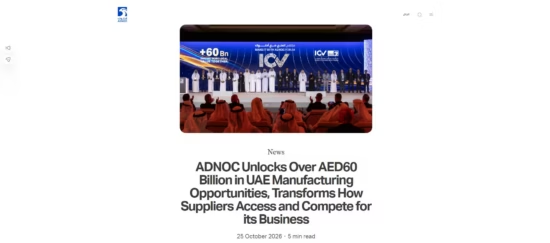
ADNOC’s official announcement dated 25 October 2026, showing more than AED60 billion in local manufacturing opportunities through 2030.
Which Manufacturing Industries Will Benefit Most From ADNOC’s 2030 Plan?
The initiative extends across several specialised industrial sectors supporting ADNOC’s upstream, downstream and operational activities.
Companies already providing equipment to the UAE energy industry may be positioned to explore additional demand.
| Manufacturing sector | Potential product opportunities |
| Rotating equipment | Compressors, industrial pumps and related machinery |
| Electrical and automation | Control systems, electrical components and instrumentation |
| Drilling equipment | Electrical submersible pumps, tubular goods and drilling-related components |
| Chemicals and catalysts | Industrial chemicals, processing materials and catalysts |
| Piping and fabrication | Seamless pipes, fabricated structures and heavy equipment |
| Advanced manufacturing | Precision components, specialised parts and maintenance spares |
Oil and Gas Equipment Manufacturing
Equipment manufacturers could benefit from opportunities involving compressors, pumps, drilling components and supporting mechanical systems.
UAE companies with established engineering capabilities may find opportunities to expand production rather than establish entirely new facilities.
Businesses exploring the wider industry can examine the capabilities of existing oil and gas companies in the UAE to understand the industrial ecosystem.
Steel Fabrication and Industrial Components
Metalworking companies may also benefit from increased requirements for fabricated equipment, specialised piping and industrial structures.
The UAE already has an established fabrication industry, with facilities providing CNC machining, welding, corrosion protection and precision engineering.
Some steel fabrication companies in Dubai possess manufacturing capabilities that could be relevant to energy-sector supply chains, subject to ADNOC’s technical approval requirements.
Automation and Advanced Manufacturing
Automation presents another potential growth area.
Industrial sensors, electrical systems, control panels and precision components are important to energy infrastructure.
Manufacturers investing in advanced production technology may be able to compete in selected product categories while supporting the UAE’s wider industrial diversification objectives.
However, the announced sector categories should not be interpreted as confirmation that every product or manufacturer will qualify for ADNOC procurement.
How Will ADNOC’s New Supplier Registration System Work?
One of the most significant developments is ADNOC’s plan to simplify supplier registration and procurement procedures.
Previously, companies could face substantial administrative requirements when registering, completing documentation and obtaining prequalification.
The new framework aims to reduce registration and qualification processing times by up to 80%.
ADNOC is also targeting a 50% reduction in required documentation and the removal of prequalification requirements for 60% of service categories.
Artificial intelligence will assist with document verification and the reuse of existing supplier information.
Manufacturers planning to participate should follow these practical stages:
- Review product opportunities: Identify manufacturing categories that match existing technical capabilities and investment plans.
- Check business licensing: Confirm the relevant UAE trade licence, permitted industrial activities and any ADNOC-specific requirements.
- Register through ADNOC: Create or connect the appropriate SAP Ariba account and complete supplier registration.
- Prepare technical documentation: Maintain quality certificates, production capabilities, safety records and product information.
- Complete applicable qualification: Undergo any required technical assessment, facility inspection or product approval.
- Monitor procurement opportunities: Review invitations to tender and opportunities involving ADNOC’s approved contractors.
Registration and prequalification are separate processes. The proposed simplifications do not eliminate technical assessments where they remain necessary.
ADNOC’s Supplier Hub also states that registration and prequalification services do not carry processing fees.
Businesses should verify the updated procedures before submitting applications, because existing portal guidance may still reflect earlier processing timelines.
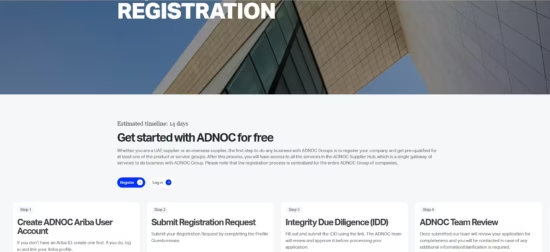
ADNOC Supplier Hub registration instructions showing account creation, registration requirements and supplier approval stages.
What Changes Are Being Made to ADNOC’s In-Country Value Programme?
ADNOC’s In-Country Value programme encourages suppliers to contribute to the UAE economy through local manufacturing, investment and workforce development.
The latest procurement reforms introduce a more integrated commercial and ICV evaluation system.
Under the model announced to take effect on 1 November 2026, bids will be evaluated using the following weighting:
| Evaluation component | Weighting |
| Commercial offer | 70% |
| In-Country Value contribution | 30% |
This replaces the previous bid-matching approach and encourages suppliers to provide competitive commercial and ICV offers from the beginning.
Two additional changes are particularly relevant for smaller suppliers.
Contracts valued below AED2 million will be exempt from ICV requirements, while contracts below AED50 million will no longer be subject to ICV retention obligations.
These changes could reduce administrative complexity and improve cash-flow conditions for qualifying businesses.
However, suppliers should not interpret the 30% weighting as a guaranteed procurement advantage. Commercial competitiveness, technical suitability and applicable tender requirements remain important.
The distinction matters because a local manufacturing facility must demonstrate real industrial value rather than rely entirely on preferential procurement treatment.
How Does the Local+ Programme Support UAE Manufacturers?
ADNOC has expanded its Local+ programme to more than 100 UAE manufacturers, compared with 70 when the initiative launched in May 2026.
Local+ is designed to give approved UAE-manufactured products priority within specified procurement categories.
Engineering, procurement and construction contractors participating in relevant new tenders must source eligible products from approved domestic manufacturers, provided applicable technical and commercial requirements are satisfied.
This creates potential demand beyond ADNOC’s direct purchases.
A manufacturer may supply equipment through major contractors working on ADNOC projects rather than contracting directly with the energy company.
For smaller industrial businesses, becoming part of an approved contractor’s supply chain could provide a practical route into larger projects.
Nevertheless, Local+ participation requires more than a UAE business address. Manufacturers must establish genuine local production capabilities and meet relevant qualification standards.
The commercial opportunity therefore depends on manufacturing readiness, product competitiveness and inclusion in the appropriate approved categories.
What Investment and Financing Support Will Manufacturers Receive?
ADNOC is collaborating with the Ministry of Industry and Advanced Technology (MoIAT) and the Abu Dhabi Investment Office (ADIO) to connect manufacturers with industrial development support.
The initiative combines visibility of future procurement requirements with information about manufacturing capabilities and potential financing.
The National Industrial Resilience Fund forms part of this wider support framework.
ADNOC also signed memoranda of understanding with ADIO and KEZAD Group during the October forum.
These arrangements could help businesses evaluate manufacturing locations, investment requirements and industrial partnerships.
However, announcements about collaboration should not be confused with automatic funding approval.
Manufacturers must still establish commercial feasibility and satisfy the conditions of any financial support programme.
Why Are Long-Term Supply Agreements Important?
Industrial investment often requires substantial upfront spending on machinery, facilities, technical personnel and product certification.
Without reliable demand, manufacturers face considerable investment risk.
Long-term purchase arrangements can improve demand visibility and support financing discussions.
Mazen Shehada, Director of Business Development at Abu Dhabi Oilfield Services Company, explained in his interview with The National that ADNOC’s offtake agreements help manufacturers invest with greater confidence.
His company has doubled its UAE manufacturing capacity since the ICV programme began and now exports from Abu Dhabi to international markets.
This provides a practical example of how domestic procurement demand can support industrial expansion and export capabilities.
How Does the AED60 Billion Announcement Compare With ADNOC’s Existing Targets?
Several large ADNOC investment figures have appeared in recent announcements, but they represent different objectives.
Understanding these distinctions is essential for investors assessing the size of the opportunity.
| Investment figure | Meaning |
| AED60 billion+ | Manufacturing opportunities identified through 2030 |
| AED90 billion | Existing local manufacturing procurement pipeline target for 2030 |
| AED80 billion | Value of local manufacturing offtake agreements signed |
| AED200 billion | Planned project awards covering 2026–2028 |
| AED307 billion+ | Economic value redirected through ADNOC’s ICV programme by the end of 2025 |
These amounts should not simply be added together because the programmes, commitments and project scopes may overlap.
The AED80 billion offtake figure refers to signed agreements, not necessarily completed manufacturing output or payments already made.
ADNOC’s programme has also supported the localisation of more than 130 products and the development or expansion of approximately 95 UAE factories.
The broader results demonstrate the scale of existing industrial participation while highlighting the importance of distinguishing confirmed achievements from future opportunities.
How Does ADNOC’s Manufacturing Plan Support Its 2030 Sustainability Strategy?
Manufacturing localisation is also connected to ADNOC’s economic development and environmental objectives.
Its 2030 Sustainability Strategy includes targets involving domestic procurement, emissions reduction, employment and industrial development.
Among the major objectives are a 25% reduction in operational emissions intensity by 2030 and progress towards net-zero operational emissions by 2045.
The strategy also includes a target to create 25,000 private-sector jobs for UAE nationals by 2028 and maintain an ICV score above 50% across its value chain.
For manufacturers, these commitments may increase the importance of efficient production processes, energy management and responsible industrial operations.
However, manufacturing locally does not automatically guarantee lower emissions. Energy consumption, raw materials, transport requirements and production efficiency all influence environmental performance.
What Should UAE Businesses Consider Before Investing in ADNOC Manufacturing Opportunities?
The AED60 billion opportunity is significant, but investment decisions require careful commercial assessment.
A manufacturer should first establish whether the targeted product has sufficient demand beyond a single project.
Important considerations include production capacity, equipment expenditure, technical certification, skilled labour availability, working capital and supply-chain reliability.
Businesses should also assess whether they can meet ADNOC’s expected delivery standards while competing with established international manufacturers.
For companies entering specialised industrial categories, partnerships with experienced engineering firms may reduce technical and operational risks.
One important consideration is the distinction between supplier registration, product qualification and actual contract awards.
Successful registration permits participation in relevant procurement processes but does not guarantee a purchase order.
Similarly, a manufacturing opportunity identified through 2030 may involve different procurement dates, quantities and commercial conditions.
A phased investment strategy may therefore be more practical than immediately committing to substantial manufacturing capacity.
Companies can begin with feasibility studies, supplier discussions and technical assessments before making major capital investments.
What Is the Long-Term Outlook for UAE Manufacturing Through 2030?
ADNOC’s manufacturing initiative could strengthen the UAE’s industrial ecosystem by linking domestic production with long-term energy-sector demand.
Established companies may benefit from additional production requirements, while newer manufacturers could identify opportunities in specialised components and supporting technologies.
The programme also presents possibilities for international manufacturers considering joint ventures or local production facilities.
As procurement processes become more streamlined, supplier participation may become more accessible.
Nevertheless, the actual economic impact will depend on how many opportunities progress into investment decisions, operational factories and completed procurement contracts.
For UAE businesses, the most promising approach is to match genuine manufacturing capabilities with verified ADNOC requirements, rather than treating the AED60 billion announcement as automatically available funding.
Frequently Asked Questions
How much has ADNOC announced for UAE manufacturing through 2030?
ADNOC announced more than AED60 billion, approximately $16.3 billion, in domestic manufacturing opportunities covering over 200 industrial products and critical spare parts.
Can small businesses become ADNOC suppliers?
Yes. Eligible small businesses can seek supplier registration and compete for appropriate opportunities, subject to applicable technical, commercial and qualification requirements.
Is ADNOC offering direct investment grants to manufacturers?
The announcement connects manufacturing opportunities with industrial support and financing initiatives. It does not establish that every manufacturer is entitled to a direct grant.
What is ADNOC’s new ICV evaluation weighting?
The announced procurement model applies 70% weighting to commercial offers and 30% to ICV contributions, with implementation scheduled from 1 November 2026.
Will all 200 products be manufactured in the UAE by 2030?
Not necessarily. ADNOC has identified opportunities to localise these products, but actual production will depend on investment decisions, supplier qualification, competitive pricing and procurement demand.