
The UAE has introduced major changes to its electronic invoicing penalty framework, reducing certain administrative fines and introducing additional protections for businesses preparing for mandatory e-invoicing.
On 30 October 2026, the Ministry of Finance announced the updated penalty framework under Cabinet Decision No. 173 of 2026, replacing Cabinet Decision No. 106 of 2025.
The revised rules introduce an AED 50,000 maximum penalty over any 12 consecutive months for specified implementation violations, remove penalties for failing to notify the Federal Tax Authority (FTA) of system failures, and reduce the administrative fine for delayed notification of changes to registration information.
The amendments follow feedback from businesses concerned about implementation costs, technical readiness and potentially disproportionate financial penalties.
However, the UAE has not abandoned mandatory electronic invoicing. Businesses must still meet their respective deadlines, appoint an Accredited Service Provider (ASP), and ensure their accounting systems can issue, transmit and receive compliant electronic invoices.
For companies approaching the 2027 implementation deadlines, understanding these UAE e-invoicing penalty updates is essential for protecting cash flow, managing regulatory risk and avoiding unnecessary compliance costs.
What Are the Latest UAE E-Invoicing Penalty Updates?
The latest changes establish a more proportionate administrative penalty framework while maintaining strict requirements for businesses that fall within the electronic invoicing system.
The updated framework makes five important changes:
- Introduces an AED 50,000 maximum penalty within any 12 consecutive months for specified implementation failures.
- Extends implementation-related penalties to issuers and recipients, including certain continuing compliance failures by recipients.
- Removes the previous AED 1,000 daily penalty for failing to notify the FTA of an electronic invoicing system failure.
- Reduces the fine for delayed notification of registration-data changes to an ASP from AED 1,000 to AED 250 per day, with a monthly cap.
- Prevents the same person from receiving duplicate penalties under the decision for the same violation when acting as an issuer, recipient or both.
The Ministry’s objective is to encourage businesses to complete their digital transition without imposing unnecessarily escalating administrative costs.
UAE E-Invoicing Penalties: Old vs New Rules
| Violation | Previous penalty under Decision 106 | Revised penalty under Decision 173 |
| Failure to implement e-invoicing or appoint an ASP | AED 5,000 per month or part-month, without a stated overall cap | AED 5,000 initially, followed by AED 5,000 for each month or part-month of continuing non-compliance; maximum AED 50,000 within 12 consecutive months |
| Failure to issue and transmit an electronic invoice | AED 100 per invoice, capped at AED 5,000 monthly | AED 100 per invoice, capped at AED 5,000 per calendar month |
| Failure to issue and transmit an electronic credit note | AED 100 per credit note, capped at AED 5,000 monthly | AED 100 per credit note, capped at AED 5,000 per calendar month |
| Failure to notify the FTA of a system failure | AED 1,000 per day or part-day | Penalty removed |
| Failure to notify the ASP of changes to FTA-registered data | AED 1,000 per day or part-day | AED 250 per day or part-day, capped at AED 5,000 per calendar month |
| Same person penalised as issuer and recipient for the same violation | No express anti-duplication provision | Only one penalty for the same violation under the decision |
These changes are established in the official Cabinet Decision No. 173 of 2026.
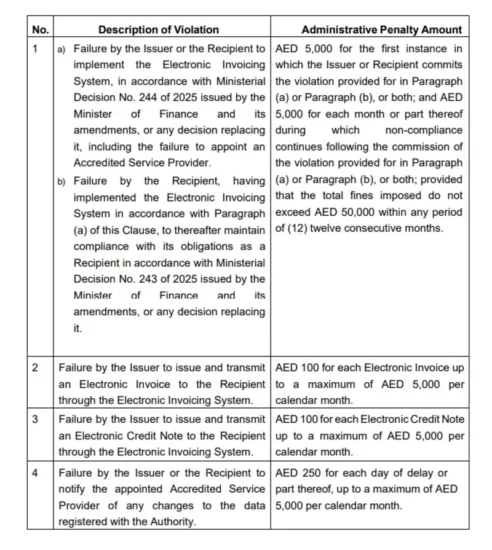
UAE Ministry of Finance’s revised electronic invoicing penalty schedule under Cabinet Decision No. 173 of 2026.
How Does the New AED 50,000 E-Invoicing Penalty Cap Work?
One of the most significant developments is the introduction of a maximum aggregate penalty of AED 50,000 within any 12 consecutive months for the implementation violations specified in item 1 of the new penalty schedule.
Previously, failure to implement the electronic invoicing system or appoint an accredited provider attracted AED 5,000 for every month or part of a month of delay, without an explicit overall cap.
Under the revised framework, an initial AED 5,000 penalty applies when a specified implementation violation occurs.
An additional AED 5,000 applies for each month or part thereof during which the non-compliance continues.
However, the aggregate fines for these specified violations cannot exceed AED 50,000 within any 12 consecutive months.
Example of How Implementation Penalties Accumulate
Consider a company that fails to meet its applicable e-invoicing obligations.
| Illustrative situation | Calculated penalty |
| Initial implementation violation | AED 5,000 |
| Initial violation plus one subsequent month of continuing non-compliance | AED 10,000 |
| Initial violation plus three subsequent months | AED 20,000 |
| Initial violation plus six subsequent months | AED 35,000 |
| Amount reaches the permitted 12-month maximum | AED 50,000 |
These figures illustrate the calculation in the revised schedule. Actual assessments depend on the timing and circumstances of the violation.
Importantly, the AED 50,000 restriction is not a universal cap on every type of e-invoicing fine.
It applies to the specified implementation and recipient compliance violations, not automatically to invoice transmission failures, electronic credit-note failures or other tax-law breaches.
From a financial planning perspective, the cap makes exposure to prolonged implementation failure easier to estimate.
Nevertheless, repeated non-compliance remains expensive. Companies should not treat the cap as an alternative to meeting their obligations.
Which UAE Businesses Must Comply With the New E-Invoicing Rules?
The UAE is introducing mandatory electronic invoicing in phases, primarily based on the revenue of businesses subject to the system.
The system is designed to enable structured electronic invoice exchange between suppliers and buyers while allowing relevant information to be reported electronically to the FTA.
The requirements cover transactions within the applicable legislative scope, including relevant business-to-business and business-to-government transactions.
UAE E-Invoicing Implementation Deadlines
| Business category | Deadline to appoint ASP | Mandatory implementation |
| Businesses with annual revenue of AED 50 million or more | 30 October 2026 | 1 January 2027 |
| Businesses with annual revenue below AED 50 million | 31 March 2027 | 1 July 2027 |
| Government entities within scope | 31 March 2027 | 1 October 2027 |
The first-phase ASP appointment deadline was extended from 31 July 2026 to 30 October 2026. The mandatory implementation date of 1 January 2027 was not postponed.
This distinction matters because appointing a provider and becoming technically operational are separate requirements.
A company might meet its ASP selection deadline while still needing to complete accounting integration, invoice validation, testing and staff training before implementation.
Anish Mehta, partner at Finerio Auditors and Advisors, highlighted the mounting pressure on companies to appoint providers and complete the separate technical implementation milestone when discussing the October deadline.
His assessment reinforces an important practical point: signing an ASP contract alone does not establish that every electronic invoicing obligation has been satisfied.
Businesses should also review their existing UAE VAT compliance requirements because electronic invoicing introduces operational reporting requirements alongside established tax obligations.
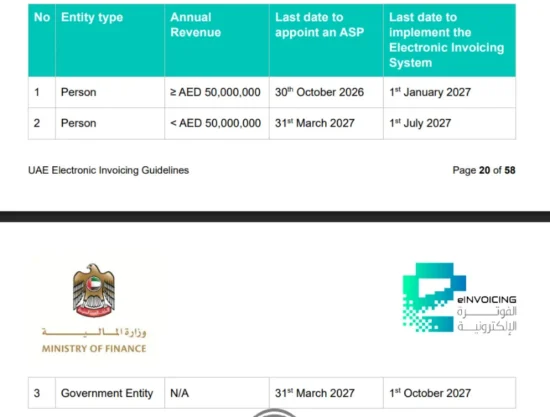
Official UAE electronic invoicing implementation requirements and phased business compliance deadlines.
Why Has the UAE Removed the System Failure Notification Penalty?
Under the earlier penalty framework, issuers and recipients could face administrative fines of AED 1,000 for each day or part thereof of delay in notifying the FTA about an electronic invoicing system failure.
These penalties created potential financial exposure during technical disruptions, including circumstances where a business might depend on an external service provider to restore normal operations.
The October 2026 amendments remove this specific administrative penalty.
This change is connected to Ministerial Decision No. 197 of 2026, which amended the broader electronic invoicing requirements and repealed the previous system-failure notification provision.
The amendment to those operational rules took effect on 1 October 2026.
The removal recognises that the responsibility for technical disruption management must be considered within the broader service-provider framework.
However, companies should not interpret the revised law as permission to disregard system outages.
Businesses remain responsible for maintaining appropriate controls over invoice generation, submission, reconciliation and recovery after technical interruptions.
A practical approach includes maintaining service-provider incident records, monitoring failed transmissions and ensuring outstanding invoices are processed when systems become available.
For finance managers, the important distinction is between removing a specific notification penalty and removing the underlying obligation to maintain compliant invoicing processes.
The former has happened; the latter has not.
What Happens if a Business Fails to Update Its Accredited Service Provider?
Another important change concerns the notification of changes to information registered with the FTA.
Previously, failing to notify the appointed ASP of relevant registration-data changes within the required timeframe attracted AED 1,000 for each day or part thereof of delay.
Under Cabinet Decision No. 173 of 2026, the revised penalty is:
- AED 250 for each day or part thereof of delay.
- A maximum of AED 5,000 per calendar month.
This represents a 75% reduction in the daily fine, alongside a new monthly ceiling.
The changes may involve business registration details and other information held by the tax authority that must remain consistent with the service provider’s records.
For example, a company undergoing changes to its legal details or registered business information should ensure that the appropriate updates are communicated to its ASP within the prescribed timeframe.
Example of the Reduced Daily Fine
| Delay | Revised fine |
| 1 day | AED 250 |
| 4 days | AED 1,000 |
| 10 days | AED 2,500 |
| 20 days | AED 5,000 |
| 25 days within one calendar month | AED 5,000 maximum |
For comparison, a ten-day delay under the previous AED 1,000 daily rate would have produced an AED 10,000 penalty.
Under the new framework, the corresponding amount is AED 2,500.
That represents a reduction of AED 7,500 in this illustrative example.
Although the new charges are lower, businesses should maintain a defined process for ensuring their ASP receives relevant updates promptly.
Can UAE Businesses Receive Multiple Penalties for the Same E-Invoicing Violation?
Cabinet Decision No. 173 of 2026 introduces express protection against duplicate penalties for the same violation.
Article 3 provides that where the same person acts as an issuer, recipient or both in relation to the same violation, only one administrative penalty is imposed under the decision for that violation.
This clarification is particularly relevant to businesses operating complex accounting and procurement systems.
Many companies both issue sales invoices and receive supplier invoices through their electronic invoicing infrastructure.
Without a clear rule, businesses could face uncertainty about whether a single compliance failure might result in overlapping penalties based on their different capacities.
The revised provision addresses that concern.
However, this protection does not mean that unrelated violations automatically merge into one penalty.
For example, repeated failure to issue electronic invoices and a separate failure involving electronic credit notes remain distinct categories under the legislative schedule.
Finance teams should therefore document the exact nature of any alleged non-compliance before reviewing the amount assessed.
How Much Are the Fines for Missing Electronic Invoices or Credit Notes?
The government has retained the previous penalty amounts for failing to issue and transmit electronic invoices and electronic credit notes through the required system.
Businesses required to issue electronic invoices may be charged AED 100 per non-compliant invoice, subject to an AED 5,000 ceiling per calendar month.
A corresponding AED 100 per document penalty applies to electronic credit notes, also subject to a separate AED 5,000 monthly ceiling.
Electronic Invoice Penalty Examples
| Non-compliant electronic invoices in a calendar month | Illustrative penalty |
| 5 | AED 500 |
| 15 | AED 1,500 |
| 30 | AED 3,000 |
| 50 | AED 5,000 |
| 75 | AED 5,000 |
These examples assume each document constitutes a violation under the decision.
The penalties for invoice and credit-note failures are listed separately. Therefore, businesses should not assume that the AED 5,000 monthly maximum automatically covers both categories together.
It is also important to distinguish ordinary PDF invoices from structured electronic invoices.
Sending a PDF to a customer by email does not, by itself, satisfy the UAE’s structured electronic invoicing requirements.
The government expects invoices to be exchanged using the approved technical framework, with the relevant electronic data transmitted through the system.
This makes transaction-level monitoring especially important for businesses processing large numbers of invoices.
A company generating hundreds or thousands of invoices each month should have controls to identify rejected transmissions, incorrect customer details and unsuccessful document exchanges before problems accumulate.
Do the UAE E-Invoicing Penalties Apply to Voluntary Participants?
The revised Cabinet Decision preserves an exclusion for people participating in the electronic invoicing system voluntarily in accordance with the applicable rules.
This means businesses that adopt electronic invoicing before becoming subject to mandatory implementation are not automatically exposed to the specific penalties in the decision merely because they have joined the voluntary phase.
Voluntary implementation began on 1 July 2026.
It allows businesses to test their technology, improve data accuracy and prepare staff before their compulsory implementation dates.
However, businesses should understand two important points.
First, voluntary adoption does not eliminate separate obligations arising under existing VAT and tax-procedure legislation.
Second, the exclusion does not continue indefinitely once the business becomes mandatorily subject to electronic invoicing.
The voluntary period provides an opportunity to identify and resolve compliance weaknesses before the applicable mandatory requirements take effect.
For SMEs, that makes early testing particularly valuable.
How Do the October 2026 Changes Affect VAT Groups and Invoice Storage?
The updated penalty framework forms part of a broader set of October 2026 electronic invoicing amendments.
Ministerial Decision No. 197 of 2026 introduces two operational changes that can substantially affect compliance planning.
Temporary Exclusion for Transactions Within VAT Tax Groups
Transactions between members of the same VAT Tax Group are temporarily excluded from electronic invoicing requirements for 24 months beginning on 1 January 2027.
This period runs through 31 December 2028.
The exclusion gives affected businesses additional time to adjust their internal invoicing processes.
It should not be confused with a general exemption for all transactions between related companies.
Businesses must confirm whether the entities involved belong to the same qualifying Tax Group rather than simply being under common ownership.
Sales to customers outside the group may remain within the mandatory e-invoicing scope.
Removal of the UAE Data Storage Location Requirement
The same ministerial amendment removes the previous requirement that electronic invoice and credit-note data be stored inside the UAE.
Businesses subject to the system must still retain the required records for the legally prescribed period and make them available to the FTA when requested.
For companies using international cloud accounting platforms, the amendment provides greater flexibility in designing data-storage arrangements.
Nevertheless, removing a geographic storage restriction does not remove responsibility for accessibility, record retention, data integrity or applicable data-protection requirements.
How Can Businesses Avoid UAE E-Invoicing Penalties?
Businesses should approach the new requirements as a financial controls and systems-integration project rather than a simple software purchase.
The revised fines may be lower in several areas, but operational failures can still create compliance costs, interrupted business processes and potentially wider tax risks.
A practical preparation plan should focus on the following actions.
- Confirm the applicable implementation phase. Review the business’s revenue, transaction types and relevant legal scope to identify its deadlines.
- Appoint an accredited service provider. Verify the provider’s accreditation through the Ministry of Finance rather than assuming that a software vendor or reseller is automatically approved.
- Integrate accounting and invoicing systems. Ensure required transaction information can be exchanged in the approved structured electronic format.
- Test invoices and credit notes. Verify successful transmission, document validation, customer identification and exception handling before mandatory implementation.
- Monitor rejected transactions. Establish a daily process for investigating failed transmissions and outstanding documents.
- Maintain accurate registration details. Assign responsibility for notifying the ASP when relevant FTA-registered information changes.
- Retain supporting records. Keep appropriate invoice data, transaction logs and supporting documentation available for tax-compliance reviews.
- Review service-provider contracts. Clarify responsibility for service availability, incident management, support, reporting and recovery procedures.
Abdulaziz Mohammed Al Mulla, Director General of the Federal Tax Authority, described the e-invoicing programme as being in a transition phase during a September 2026 industry awareness event.
He explained that the authority’s increasing focus was on helping businesses move from understanding the requirements to actual preparation and onboarding.
That distinction is important because theoretical familiarity with the regulations will not necessarily prevent errors during daily invoicing operations.
Companies should also assess the connection between electronic invoicing and their existing tax controls.
For example, inaccurate invoice information can create complications beyond the specific electronic invoicing penalty schedule, including problems involving VAT returns, supporting documentation and tax corrections.
Reviewing the UAE’s updated tax penalty framework can help businesses understand why different administrative penalties must be considered separately.
What Are the Financial Implications of the New E-Invoicing Penalty Rules?
The revised penalties provide businesses with greater predictability, particularly where technical implementation delays continue for several months.
The AED 50,000 cap on specified implementation penalties reduces the risk of unlimited accumulation within the defined 12-month period.
Similarly, reducing the notification-related daily fine from AED 1,000 to AED 250 provides more proportionate treatment of administrative delays.
However, businesses should distinguish between the cost of achieving compliance and the financial consequences of remaining non-compliant.
An electronic invoicing budget may need to cover:
- Accredited service-provider fees.
- Accounting software integration or upgrades.
- Data cleansing and customer information verification.
- Staff training and operational testing.
- Monitoring, technical support and internal controls.
- Ongoing compliance maintenance.
The financial benefits of implementation should also be considered.
Automated invoicing can reduce repetitive administrative work, improve transaction visibility, support reconciliation and make invoice information more consistent across business systems.
For finance directors, the most effective approach is to compare the total cost of implementing an appropriate system against the risks and operational inefficiencies of delayed adoption.
Businesses should not assume that all accounting or reporting errors will be covered by the revised e-invoicing penalty limits.
Separate VAT obligations continue to operate under their own legal framework.
Companies managing outstanding input tax or supporting invoice documentation may also find it useful to review the current UAE VAT refund rules, particularly where accurate records are important to substantiating claims.
When Do the Revised UAE E-Invoicing Penalty Rules Take Effect?
Cabinet Decision No. 173 of 2026 was publicly announced by the Ministry of Finance on 30 October 2026.
Article 5 of the decision states that it comes into force on the day following publication in the Official Gazette.
Federal Official Gazette No. 833, dated 14 October 2026, has been reported as containing the decision, indicating an effective date of 15 October 2026.
Businesses reviewing violations around the October 2026 transition should verify the applicable legal commencement date and the circumstances of any assessment rather than assuming the announcement date determines when the rules became enforceable.
The implementation deadlines for businesses remain separate from the commencement date of the penalty decision.
The revised framework therefore changes how specified violations are penalised; it does not automatically postpone the mandatory rollout or grant businesses a general exemption from compliance.
Frequently Asked Questions
What is the new e-invoicing penalty in the UAE?
The revised rules impose AED 5,000 for specified implementation violations, followed by AED 5,000 per month or part-month of continuing non-compliance, capped at AED 50,000 within any 12 consecutive months.
Has the UAE removed all e-invoicing penalties?
No. The government has removed the specific penalty for failing to notify the FTA of a system failure, while retaining fines for implementation failures, electronic invoices, credit notes and certain notification delays.
Is the AED 50,000 penalty cap applicable to every violation?
No. The AED 50,000 cap applies to the implementation-related violations specified in item 1 of the new penalty schedule.
What is the penalty for failing to issue an electronic invoice?
The penalty is AED 100 per electronic invoice, with a maximum of AED 5,000 per calendar month under the relevant penalty category.
When does UAE electronic invoicing become mandatory?
Mandatory implementation begins on 1 January 2027 for businesses with revenue of AED 50 million or more, followed by 1 July 2027 for smaller businesses within scope.
Do voluntary e-invoicing users face penalties?
The specific penalties under Cabinet Decision No. 173 do not apply to qualifying voluntary participation before the applicable mandatory requirements begin.
Can a company receive duplicate penalties as an issuer and recipient?
The new decision expressly prevents imposing more than one administrative penalty on the same person for the same violation under its provisions.
Is PDF invoicing sufficient for UAE e-invoicing compliance?
No. A normal PDF or emailed invoice is not automatically a compliant electronic invoice. The system requires structured electronic invoice exchange through the approved framework.