The UAE new traffic regulations 2027 will introduce major changes affecting motorists, vehicle owners, delivery drivers, businesses and electric scooter riders across the country.
From 1 January 2027, new federal requirements will regulate driving hours, vehicle registration, driving licence assessments, child passenger safety and road use.
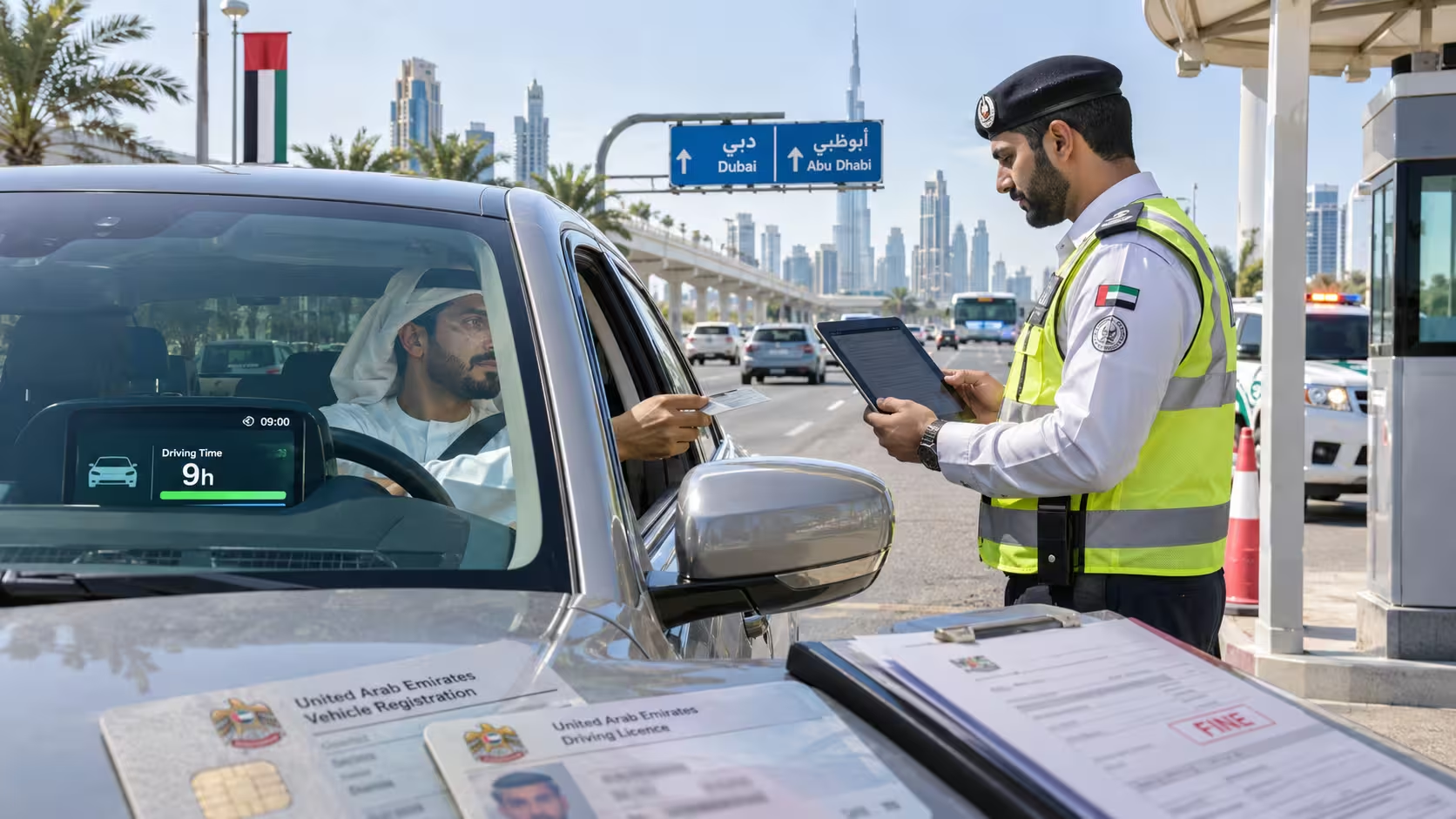
One of the most significant changes is a maximum of nine hours of driving within any 24-hour period.
The regulations also introduce a five-vehicle registration limit for individual residents, additional fees for registering more than two vehicles and a two-year registration option for eligible light vehicles.
The changes are established under Cabinet Decision No. 174 of 2026, which implements Federal Decree-Law No. 14 of 2024 concerning traffic regulation.
According to the Emirates News Agency’s official announcement, the new framework is designed to strengthen road safety, regulate modern transportation and establish clearer responsibilities for drivers.
What Are the UAE New Traffic Regulations for 2027?
The new legislation establishes a comprehensive framework for vehicle licensing, road safety, professional transportation and personal mobility devices.
Rather than focusing exclusively on traffic fines, the regulations introduce requirements covering how long motorists may drive, which vehicles can be registered and how driving competency is assessed.
The principal changes are summarised below.
| New traffic regulation | Requirement from January 2027 |
| Maximum driving hours | Nine hours within any 24-hour period |
| Driver fatigue | Driving while dangerously fatigued is prohibited |
| Residential road speed | Maximum 40 km/h on internal residential roads |
| Resident vehicle registration | Maximum five registered vehicles |
| Additional vehicle fees | Extra charges for third, fourth and fifth vehicles |
| Light vehicle registration | Two-year option for eligible vehicles, subject to approval |
| Electric scooter permits | Minimum applicant age of 15 |
| Scooter permit validity | Three years |
| Driving theory test | Minimum 75% passing score |
| Practical driving test | Minimum 75%, subject to safety-related failure conditions |
| Child safety seats | Required for children aged four and under |
| Delivery motorcycles | No passengers during deliveries or backpacks carrying orders |
These requirements will affect private motorists and commercial transport operators, although some implementation procedures remain subject to clarification by the relevant authorities.
When Will the New UAE Traffic Rules Come Into Effect?
The new regulations are scheduled to take effect on Friday, 1 January 2027.
Cabinet Decision No. 174 of 2026 was issued on 6 October 2026 and published in the Federal Official Gazette on 14 October 2026.
The decision provides the implementing framework for the UAE Federal Traffic Law, which establishes the broader legal responsibilities of road users and licensing authorities.
The January implementation date is important because motorists must distinguish between existing requirements and changes that have been announced but are not yet operational.
Authorities in Dubai, Abu Dhabi, Sharjah and other emirates may also publish additional procedures explaining how federal requirements will be administered locally.
What Is the New Nine-Hour Driving Limit in the UAE?
Article 7 establishes a maximum driving duration of nine hours within any 24-hour period.
It also prohibits motorists from operating vehicles while suffering from fatigue or exhaustion that compromises their ability to drive safely.
The restriction appears under the general obligations of vehicle drivers rather than exclusively under provisions governing professional transport operators.
This makes the precise application of the rule to private motorists an important matter for further official clarification.
How the Nine-Hour Limit Works?
The regulation refers to total driving time within a 24-hour period, rather than simply permitting a single uninterrupted nine-hour journey.
For example, a person driving for five hours during the morning and another four hours later would accumulate nine hours of driving.
A break does not automatically reset the accumulated driving time.
However, the published provisions do not yet establish a detailed method for calculating, recording or monitoring individual driving hours.
They also do not specify mandatory rest intervals or a separate fine expressly attached to exceeding the nine-hour ceiling.
The Federal Traffic Council has authority to modify the limit under the regulation.
Why Driver Fatigue Is a Major Concern?
Driver fatigue can affect reaction times, concentration, vehicle control and the ability to recognise hazards.
According to Ministry of Interior figures reported in November 2026, the UAE recorded 20 traffic accidents attributed to driver fatigue and drowsiness during 2025.
Following a fatigue-related truck accident on Emirates Road in October 2026, Brigadier Juma Salem bin Suwaidan, Director of the General Department of Traffic at Dubai Police, urged motorists to obtain sufficient rest and stop driving when they become tired.
Drivers should therefore recognise that remaining below nine hours does not automatically make continued driving safe.
Road-safety guidance recommends taking regular breaks, obtaining sufficient sleep and avoiding driving when experiencing repeated yawning, delayed reactions or difficulty maintaining lane position.
How Will the New Traffic Regulations Affect Professional Drivers?
Professional drivers are among those potentially most affected by the changes.
Taxi operators, logistics companies, bus services, courier businesses and delivery platforms may need to examine their scheduling practices.
Article 10 also establishes specific requirements for professional drivers, including valid professional permits and compliance with approved vehicle systems.
Road-safety expert Mustafa Aldah, speaking to The National in November 2026, welcomed stronger regulation of professional transport.
He emphasised that responsibility for safe operations should extend beyond the person operating the vehicle.
“That needs to be a chain of responsibility: it starts with a driver and ends with the owner or director of the company.”
His assessment raises an important consideration for transport businesses: preventing fatigue requires realistic delivery schedules, appropriate staffing and properly maintained vehicles.
Although the new decision establishes obligations for drivers, the detailed enforcement arrangements and any additional employer-specific responsibilities will need to be assessed against applicable legislation and official guidance.
What New Rules Will Apply to Delivery Riders?
Delivery drivers will face additional operational requirements under Article 10.
These rules are particularly relevant to food delivery services, courier platforms and businesses operating motorcycle fleets.
The requirements include:
- Carrying a valid professional permit and presenting it when requested.
- Wearing the prescribed uniform while performing delivery duties.
- Using approved vehicle systems in accordance with instructions.
- Not carrying passengers on motorcycles while delivering orders.
- Not transporting delivery orders in backpacks.
- Using designated and approved equipment for carrying deliveries.
- Not transporting prohibited goods.
For delivery companies, the backpack restriction could require changes to existing rider equipment and delivery procedures.
Businesses should review whether their motorcycles use compliant storage equipment before the January implementation date.
What Are the New Residential Speed Limits and Road Safety Rules?
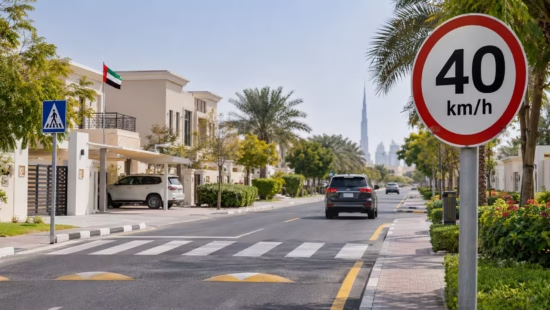
Article 8 establishes a maximum speed of 40 km/h on internal residential roads, with speed restrictions communicated through appropriate traffic signs.
Motorists must continue obeying posted limits, including lower limits where applicable.
The regulations also strengthen obligations concerning pedestrian protection, overtaking and safe vehicle manoeuvres.
Drivers must reduce their speed when approaching schools, hospitals, pedestrian crossings, intersections, bends and areas with limited visibility.
When turning into another road, motorists must allow pedestrians who have already started crossing to proceed safely.
The provisions also prohibit dangerous reversing, unauthorised motorway U-turns and stopping outside designated areas.
These measures complement existing road-safety enforcement, including the Dubai Police Quiet Roads initiative, which targets reckless driving, dangerous vehicle modifications and excessive noise in residential communities.
What Are the New Child Car Seat Regulations?
Article 11 requires suitable child safety seats for children aged four and under.
Child seats must be appropriate for the child’s weight and height, comply with applicable safety standards and ordinarily be installed in rear passenger seats.
Exceptions to the Rear-Seat Requirement
The regulations recognise limited circumstances in which the normal seating arrangement may not be possible.
Where a child’s medical condition prevents the use of a standard protective seat, an official medical certificate and an accompanying attendant in the rear seat are required.
For vehicles without rear seats, a child safety seat may be installed in the front if it is rear-facing and the airbag is deactivated.
This is a specific exception rather than general permission to place young children in front passenger seats.
Drivers and passengers must also comply with the applicable seat-belt requirements.
How Will Electric Scooter Rules Change in 2027?
Electric scooters, electric bicycles and other personal mobility devices will come under a more detailed federal regulatory framework.
Article 59 introduces three permit categories covering electric bicycles, electric scooters and small-wheeled cycles.
The minimum age for obtaining these permits will be 15 years, and permits will remain valid for three years.
However, riders will only be permitted to use designated roads and routes approved by the relevant authorities.
Electric Scooter Safety Requirements
Article 4 introduces technical standards covering the condition and equipment of personal mobility devices.
These include:
- A functioning front light for visibility at night.
- A rear position light and red brake light.
- An audible warning device.
- At least one brake on the rear wheel.
- Properly maintained tyres and wheel components.
- Additional technical requirements imposed by licensing authorities.
Dubai’s existing scooter permit arrangements have used a minimum age of 16, making the upcoming federal threshold an important development.
Riders should consult current local rules until the new provisions are implemented.
Detailed application requirements are covered in the Dubai e-scooter permit guide and the electric scooter licence application process.
What Are the New Vehicle Registration Rules for 2027?
Vehicle registration is another major component of the new framework.
Under Article 89, individual UAE residents may register a maximum of five vehicles.
The first two vehicles remain subject to ordinary registration requirements, while additional fees apply to the third, fourth and fifth vehicles.
The additional fee amounts have not yet been confirmed.
The provision specifically addresses individual residents and should not automatically be interpreted as imposing the same numerical restriction on company-owned fleets.
It also does not establish a confirmed transitional arrangement for residents already holding registrations for more than five vehicles.
Our examination of the published requirements indicates that residents should avoid making assumptions about existing registrations until the relevant authorities explain their treatment.
The UAE five-car registration limit for 2027 provides a more detailed explanation of the ownership categories, additional fees and unresolved transitional questions.
Two-Year Registration for Eligible Vehicles
Article 98 introduces an option to extend light vehicle registration from one year to two years.
The longer period is not automatic.
It is subject to approval by the relevant licensing authority and applies to qualifying vehicles that were brand new when first registered and are no more than six years old from their manufacture date.
For motorists, this could reduce the frequency of registration transactions, although insurance, inspection and other applicable obligations must still be met.
Owners can review the online vehicle registration renewal process to understand existing documentation and service channels.
The regulations also restrict licensing right-hand-drive vehicles for ordinary road use, permitting them for exhibition purposes.
Will UAE Driving Licence Rules Change in 2027?
The implementing regulations clarify driving licence eligibility, validity periods and testing requirements.
Under Article 55, licence validity depends on age, nationality and whether the licence is being issued for the first time.
| Driver category | Licence validity |
| Applicants under 21 | One year |
| First-time applicants aged 21 or above | Two years |
| UAE and GCC nationals on subsequent renewal | Ten years |
| Expatriate residents on subsequent renewal | Five years |
The regulations also establish different minimum ages depending on vehicle category.
The minimum age for a light vehicle driving licence is 18, while heavy vehicle applicants must be at least 20.
Certain motorcycle licence categories begin at 17, while bus licence applicants must generally be at least 21.
For existing licence holders, renewal continues to depend on meeting the applicable medical, identification and administrative requirements.
Dubai motorists can also review the RTA driving licence renewal machine process.
What Are the New UAE Driving Test Requirements?
Articles 65 and 68 establish a minimum passing score of 75% for theory and practical assessments.
However, obtaining 75% does not necessarily guarantee success in the practical examination.
Applicants can fail because of dangerous driving errors or situations requiring examiner intervention.
Examples include losing control of the vehicle, failing to obey traffic signals, unsafe manoeuvres and other mistakes creating a risk to road users.
UAE legal consultant Dr Hassan Elhais explained in comments published in October 2026 that the 75% threshold and safety-related failure principle were already present in earlier regulations.
His analysis indicates that the updated rules provide clearer expression of existing safety standards rather than introducing an entirely new passing threshold.
For learner drivers, the important distinction is between achieving the required score and demonstrating consistently safe vehicle control.
What Are the Rules for Cyclists and First Aid?
Article 9 establishes further responsibilities for cyclists, including wearing helmets, travelling in single file unless circumstances require otherwise and avoiding dangerous riding behaviour.
Cyclists must not use other vehicles to tow their bicycles and may only carry passengers where their bicycles are designed for that purpose.
Article 13 also establishes conditions for administering first aid to people injured in traffic accidents.
The provision addresses accredited first-aid training, certificate validity where relevant and the physical ability to assist safely.
Drivers witnessing an accident should prioritise scene safety, contact emergency services and follow instructions from qualified responders.
Will There Be New Traffic Fines in the UAE in 2027?
The new implementing regulations introduce additional obligations, but that does not mean every requirement has a separately announced monetary penalty.
As of November 2026, a specific fine for exceeding the nine-hour driving limit has not been clearly established in the published reporting.
Similarly, the additional registration charges for a third, fourth or fifth vehicle should not be confused with a traffic offence penalty.
Existing fines, black points and other sanctions under UAE traffic legislation remain relevant.
Motorists can also review the UAE driver traffic point reduction programme for information about the country’s road-safety incentive initiatives.
Drivers should check official Ministry of Interior, police and licensing authority announcements for enforcement instructions and confirmed penalty schedules.
What Should Motorists and Businesses Do Before January 2027?
The new rules give road users an opportunity to review their compliance arrangements before implementation.
Motorists should check vehicle registrations, driving licence validity, child seating arrangements and vehicle maintenance.
Residents owning several vehicles should verify their registration records and monitor announcements concerning additional fees.
Electric scooter users should confirm the permit requirements and approved riding routes applicable in their emirate.
Transport and delivery businesses should review driver schedules, professional permits, motorcycle storage equipment and vehicle safety procedures.
Fleet operators should also monitor forthcoming clarification of how the nine-hour driving limit will be recorded and enforced.
Most importantly, drivers should not wait for January 2027 to adopt safer practices concerning fatigue, seat belts, distraction and pedestrian safety.
FAQs About UAE New Traffic Regulations 2027
Can you drive more than nine hours in the UAE from 2027?
Article 7 establishes a maximum of nine hours of driving within any 24-hour period. Further clarification may be issued concerning enforcement and its application to different driver categories.
Do the new traffic regulations apply to private drivers?
The nine-hour provision appears under general driver obligations rather than exclusively under professional driving requirements. However, practical enforcement and scope remain matters requiring clarification.
What is the minimum age for an electric scooter permit in 2027?
The federal regulation sets a minimum permit application age of 15. Riders must also comply with authorised route restrictions and other applicable safety requirements.
How many vehicles can a UAE resident register?
Individual residents will be permitted to register up to five vehicles, with additional charges applying beyond the first two. The specific extra fee amounts have not yet been confirmed.
Can all vehicles receive two-year registration?
No. The option concerns eligible light vehicles, subject to age conditions and licensing authority approval.
Is 75% enough to pass a UAE driving test?
Not necessarily. Applicants must achieve the required score while avoiding dangerous mistakes that can independently result in practical-test failure.
When will the new UAE traffic rules become effective?
Cabinet Decision No. 174 of 2026 is scheduled to take effect on 1 January 2027.