
Registering for VAT in the UAE is an important compliance step for businesses that meet the required taxable turnover conditions. The process is managed by the Federal Tax Authority through EmaraTax, where businesses can create their taxable person profile, submit registration details and upload supporting documents online.
In 2026, UAE-resident businesses generally need to register when taxable supplies and imports exceed AED 375,000 over the previous 12 months or are expected to exceed this amount within the next 30 days. Businesses with taxable supplies, imports or qualifying expenses above AED 187,500 may also be eligible for voluntary registration.
Businesses should also be aware that UAE tax legislation continues to evolve. The UAE VAT rules introduced for 2026 include changes affecting areas such as documentation, input tax recovery and VAT refund procedures, making accurate tax management increasingly important.
VAT registration itself is free. A prepared online application can take around 45 minutes to complete, while the FTA generally provides a processing estimate of up to 20 business days for a completed application.
Who Needs to Register for VAT in the UAE?
VAT registration depends primarily on taxable turnover, expected taxable business activity and whether the person carrying out the activity is resident or non-resident in the UAE.
Mandatory VAT Registration
A UAE-resident business generally needs to register when the total value of its taxable supplies and imports:
- Exceeds AED 375,000 During the Previous 12 Months
- Is Expected to Exceed AED 375,000 Within the Next 30 Days
The threshold is not limited to the financial year. Businesses should monitor taxable turnover continuously because the test looks at a rolling 12-month period as well as expected activity during the following 30 days.
Voluntary VAT Registration
A business that has not reached the mandatory AED 375,000 threshold may still be able to register voluntarily.
The voluntary registration threshold is generally AED 187,500. A business may qualify when its taxable supplies and imports or qualifying taxable expenses exceed that amount during the previous 12 months or are expected to exceed it during the following 30 days.
Non-Resident Businesses
Different requirements can apply to businesses that do not have a place of residence in the UAE.
A non-resident business making taxable supplies in the UAE may be required to register even where it has not reached the AED 375,000 threshold, particularly when no other UAE person is responsible for accounting for VAT on those supplies.
What Counts Towards the VAT Registration Threshold?
The calculation can generally include:
- Standard-Rated Supplies subject to the 5% VAT rate
- Zero-Rated Supplies that remain taxable even though VAT is charged at 0%
- Relevant Taxable Imports
- Other Taxable Supplies that fall within the applicable VAT rules
Businesses should not automatically use the total revenue figure appearing in their accounts without considering the VAT treatment of each activity. Zero-rated supplies can still count towards the registration threshold, while exempt supplies are treated differently.
When Should You Apply for VAT Registration?
Businesses should assess VAT registration throughout the year rather than waiting until annual accounts are completed.
The requirement can arise because the historical 12-month threshold has been crossed or because the business reasonably expects to exceed the threshold during the next 30 days.
Late registration can result in penalties and may create additional accounting work where VAT obligations apply from an earlier effective registration date.
How to Register for VAT in UAE Through EmaraTax?
VAT registration is completed through the Federal Tax Authority’s EmaraTax system. Businesses should prepare their corporate documents and financial evidence before beginning the application.
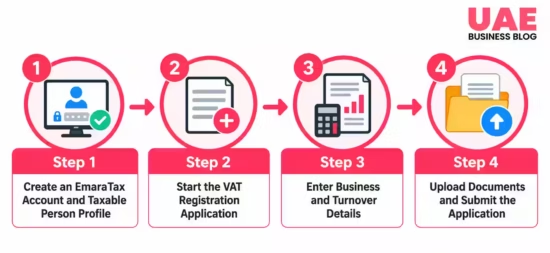
Step 1: Create an EmaraTax Account and Taxable Person Profile
Create an EmaraTax account and complete the required account verification. Once logged in, create a Taxable Person Profile for the person or legal entity that needs VAT registration.
The information entered should match the legal records of the business. Businesses that need to confirm whether their licence details remain valid can first check their UAE trade licence information online before submitting registration information.
Step 2: Start the VAT Registration Application
Open the relevant Taxable Person Account and locate the registration option under Value Added Tax. The application asks why the business is registering and requests details about its legal form, business activities and VAT position.
Step 3: Enter Business and Turnover Details
The business must provide accurate commercial and financial information, which can include:
- Legal business name
- Trade licence information
- Business activities
- Registered address
- Owners and authorised signatories
- Historical taxable turnover
- Expected taxable turnover
- Imports and exports
- Customs registration details where applicable
Historical turnover may be supported by issued invoices and accounting records, while future turnover may require contracts, purchase orders or other commercial evidence.
Step 4: Upload Documents and Submit the Application
Upload the supporting documents requested for the applicant’s legal form and circumstances. Review legal names, licence numbers, turnover calculations, ownership details, contact information and attached documents before submission.
What Documents Are Required for VAT Registration?
Document Why It May Be Required
Trade Licence Confirms licensed business activities
Commercial Registration Certificate Supports legal registration details
Certificate of Incorporation Confirms formation of the legal entity
Memorandum of Association Shows ownership and company structure
Emirates ID Verifies relevant UAE-based individuals
Passport Copy Supports identity verification
Power of Attorney Confirms authority where another person acts for the business
Turnover Declaration Supports taxable turnover calculations
Sales Invoices Provides evidence of completed taxable supplies
Contracts and Purchase Orders Can support expected future turnover
Customs Records Relevant to businesses involved in imports and exports
Do Free Zone Businesses Need VAT Registration?
Being established in a UAE free zone does not automatically remove the obligation to register for VAT. A free zone business may still need to register when its taxable activities exceed the relevant registration threshold.
Companies operating from locations such as the various Sharjah free zones should therefore consider VAT separately from the commercial advantages associated with their free-zone licence.
Businesses should also understand the distinction between a general free zone and a VAT Designated Zone. Certain transactions involving goods within qualifying Designated Zones can receive specific VAT treatment, but that does not mean every transaction falls outside VAT.
How Long Does VAT Registration Take From Start to Finish?
Stage Typical Time
Preparing Documents Depends on Business Readiness
Completing the EmaraTax Application Around 45 Minutes
FTA Review of a Completed Application Up to 20 Business Days
Additional Information Requests May Extend the Process
Receiving the VAT Registration Certificate After Approval
The 20-business-day processing estimate should not be interpreted as a guaranteed approval period for every application. Missing or inconsistent documents can extend the overall process.
How Much Does VAT Registration Cost in the UAE?
The Federal Tax Authority does not charge a fee for the standard VAT registration service through EmaraTax. This means the government registration cost is AED 0. Businesses may still choose to pay an accountant, tax consultant or other professional to review or complete the application.
What Happens After You Submit the VAT Application?
The FTA reviews the application and supporting evidence. If additional information is required, the applicant may be asked to provide invoices, contracts, purchase orders, explanations of business activities or other records.
If registration is approved, the business receives a Tax Registration Number, known as a TRN, and can access its VAT registration certificate.
How Has VAT Helped Businesses, Consumers and the UAE Government?
VAT was introduced in the UAE on 1 January 2018 at a standard rate of 5%. One of its main purposes is to provide the government with a broader source of public revenue as the UAE continues to diversify its economy beyond traditional oil-related income.
For businesses, VAT has encouraged stronger financial record keeping and more formal accounting procedures. Registered businesses can also recover eligible input VAT on qualifying business expenses, subject to the applicable rules.
Consumers generally bear VAT on taxable purchases, so the broader public benefit comes through the contribution VAT makes to government revenue, infrastructure and public services.

What Should You Do After Receiving Your TRN?
Receiving the TRN means the business moves from the registration stage into ongoing VAT compliance. Start by confirming the legal name, TRN and effective registration date.
- Issuing Compliant Tax Invoices where required
- Recording Output VAT charged to customers
- Recording Eligible Input VAT on business purchases
- Maintaining Supporting Records
- Checking the Assigned Tax Period
- Submitting VAT Returns on Time
- Paying VAT Liabilities by the Applicable Deadline
Once a VAT return creates an amount payable, businesses can use EmaraTax to settle their liability. Understanding how VAT payments are made in the UAE is therefore an important part of the compliance process after registration.
VAT-registered businesses should also start preparing their systems for broader digital tax changes.
The UAE business e-invoicing compliance requirements mean businesses need to pay increasing attention to invoice data, legal entity information, VAT treatment and accounting-system readiness.
Common VAT Registration Mistakes to Avoid
Waiting Too Long to Register
- Do not wait until the financial year ends before reviewing taxable turnover.
Using the Wrong Turnover Figure
- Total accounting revenue and taxable turnover are not always the same.
Excluding Zero-Rated Supplies
- Zero-rated transactions can still be taxable supplies and may count towards the threshold.
Providing Unsupported Forecasts
- Expected turnover should be supported by credible evidence such as contracts or purchase orders.
Entering Incorrect Licence Details
- Trade licence numbers, business activities and legal names should agree with official company records.
Uploading Incomplete Documents
- Unreadable scans, expired licences and missing pages can delay the application.
Assuming Free Zone Businesses Are Automatically Exempt
- Free zone status alone does not determine whether VAT registration is required.
Ignoring FTA Requests
- Additional information requests should be answered accurately and within the required period.
Conclusion
Registering for VAT in the UAE in 2026 is manageable when businesses understand their turnover position, prepare the required evidence and use the current EmaraTax registration process.
UAE-resident businesses generally become subject to mandatory registration once taxable supplies and imports exceed AED 375,000 during the previous 12 months or are expected to exceed the threshold within the next 30 days. Voluntary registration can generally become available from AED 187,500.
VAT registration itself is free, a prepared online application may take around 45 minutes to complete and the FTA’s processing estimate for a completed application is up to 20 business days. Once the TRN is issued, businesses need accurate invoicing, accounting, return filing, payment procedures and record keeping.
FAQs
Is VAT Registration Mandatory in the UAE?
VAT registration is generally mandatory for a UAE-resident business when taxable supplies and imports exceed AED 375,000 during the previous 12 months or are expected to exceed this amount within the next 30 days.
Can I Register for VAT Below AED 375,000?
Yes. Voluntary registration may generally be available when qualifying taxable supplies, imports or expenses exceed AED 187,500.
How Long Does VAT Registration Take in the UAE?
Completing a prepared application may take around 45 minutes. The FTA provides an estimated processing period of up to 20 business days for a completed application.
Is UAE VAT Registration Free?
Yes. The standard VAT registration service through the Federal Tax Authority is free.
Do Zero-Rated Sales Count Towards the VAT Threshold?
Yes. Zero-rated supplies remain taxable supplies despite being subject to a 0% rate, so they can be relevant to the VAT registration threshold.
Do Free Zone Companies Have to Register for VAT?
They can. Being based in a free zone does not automatically exempt a company from VAT registration.
What Happens After VAT Registration Is Approved?
The business receives its TRN and VAT registration details, then moves into ongoing invoicing, record-keeping, return-filing and payment obligations.